7 Ruthless Strategies to Calculate Retail Profit Margin and Destroy Inventory Shrinkage
Most boutique owners and store managers bleed cash without realizing it until the end of the fiscal quarter. They calculate retail profit margin based purely on their wholesale cost versus the sticker price, completely ignoring the operational friction that destroys net profitability. If you are just multiplying your wholesale cost by two (standard keystone pricing) and hoping for the best, you are mathematically setting yourself up for failure.
To survive in modern brick-and-mortar or e-commerce retail, you must treat your pricing strategy like a financial fortress. Hidden variables—like employee till errors, external theft, and dead stock holding costs—will silently consume your bottom line if they aren't aggressively managed.
Quick Answer / Key Takeaways * Confusing markup (percentage of cost) with margin (percentage of selling price) is the most common reason retailers go bankrupt. * Simulating POS cash register operations to train staff before they handle live transactions drastically reduces cash shrink. * You must track Gross Margin Return on Investment (GMROI) to know exactly how much cash your inventory is generating per dollar invested.
1. Stop Confusing Markup with Gross Margin
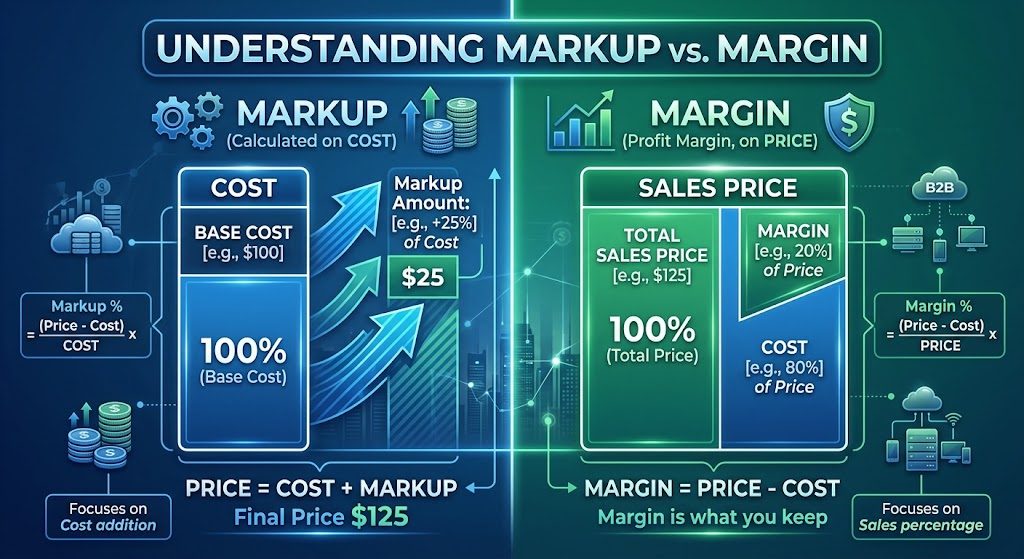
The most fatal error in retail management is using the terms "markup" and "margin" interchangeably. Markup is the percentage you add to the cost of a good to reach your selling price. Margin is the percentage of the selling price that is actual profit.
If you buy a shirt for $50 and sell it for $100, your markup is 100%, but your margin is only 50%. When you misinterpret these formulas, you will inevitably over-discount your products during sales events, accidentally selling items below your true break-even point.
2. Bake Shrinkage Benchmarks into Base Pricing
Inventory shrinkage—loss of products due to theft, administrative errors, or supplier fraud—is a guaranteed expense. According to the National Retail Federation (NRF) annual security survey, average retail shrinkage sits around 1.4% to 1.6% of total sales.
You must calculate retail profit margin with this baseline loss already factored in. If your target margin is 45%, you actually need to price your goods to achieve a 47% margin on paper. This buffer ensures that when the inevitable shrinkage occurs, your net profitability remains intact.
3. Implement Simulated POS Cash Register Training
A massive percentage of shrinkage isn't malicious; it is simple administrative incompetence at the checkout counter. An undertrained cashier fumbling with change calculations, mis-keying SKUs, or improperly processing returns causes devastating "cash shrink."
To combat this, you must train your retail staff using a simulated point-of-sale cash register environment before they ever touch live money. By running trainees through virtual till operations and complex change-calculation scenarios, you build muscle memory. This dramatically reduces transaction friction and perfectly protects your margins at the point of sale.
4. Track Gross Margin Return on Investment (GMROI)
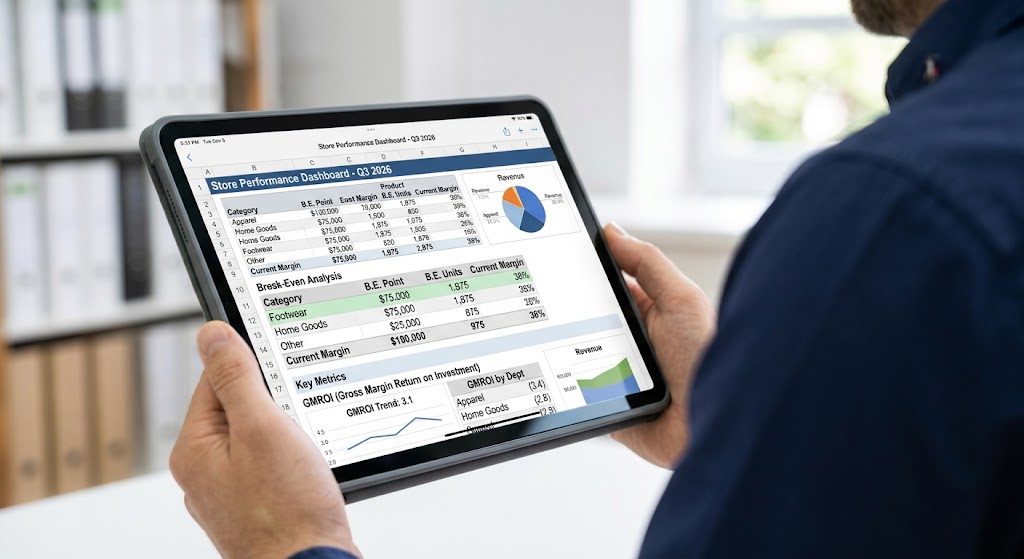
Having high-margin products means nothing if they sit on your shelves for 12 months collecting dust. You must track GMROI, which measures how much gross profit you earn for every dollar invested in inventory.
The formula is simple: Gross Margin / Average Inventory Cost = GMROI. If your GMROI is below 1.0, you are actively losing money holding that product. A healthy retail business should aim for a GMROI of 2.0 to 3.2, meaning you make $2.00 to $3.20 for every dollar tied up in stock.
5. Calculate Break-Even Unit Volumes Before Discounting
Before you run a "20% Off" weekend promotion, you must understand how that discount affects your required sales volume. If you drop your prices, your margin shrinks, meaning you have to sell significantly more units just to make the exact same gross profit.
If your item has a 50% margin and you discount it by 10%, you don't just need 10% more sales—you typically need to increase unit sales by 25% to break even on the promotion. Never run a sale without calculating this unit volume threshold first.
6. Execute Dynamic Markdowns on Dead Inventory
Holding onto dead stock out of stubbornness is a margin killer. Inventory carrying costs—insurance, storage space, and capital opportunity cost—eat away at your profits every single day.
Implement a ruthless 90-day markdown schedule. If a product hasn't moved in three months, start discounting it aggressively to free up that trapped capital. It is always better to liquidate dead stock at a break-even margin and reinvest that cash into your highest GMROI top-sellers.
7. The 48-Hour Margin Protection Audit Checklist
Stop bleeding cash today by implementing this immediate operational audit across your store.
- Audit your POS permissions: Restrict manual price overrides and void capabilities to shift-managers only to prevent internal till theft.
- Run a markup-to-margin test: Pick 10 random items on your floor and recalculate their true margin based on landed cost (including shipping and handling), not just wholesale cost.
- Stop guessing your numbers: You cannot scale a retail business on manual spreadsheet math. Use our dedicated Retail Margin Calculator to dial in your gross margins, markup percentages, and break-even points flawlessly.
For deeper business profitability analysis, including retail income projections and cash flow management strategies, visit The Income Audit for comprehensive guidance on scaling your retail operations sustainably.
If you are struggling to train your staff on cash handling, understanding the fundamentals of retail profitability and operational efficiency is critical. Master these strategies first, then optimize with our calculator.