E-Commerce Return Rate and Reverse Logistics Margin Formula: 5 Essential Net Profit Calculations
In direct-to-consumer (DTC) e-commerce and marketplace retail, product returns are never a simple revenue reversal. A widespread accounting blind spot—frequently highlighted in r/ecommerce cost-of-returns audits—is assuming that a 15% return rate simply reduces your store's gross profit by 15%. In reality, because every returned parcel triggers a cascade of non-recoverable outbound postage, return label freight, non-refundable payment gateway fees, third-party logistics (3PL) inspection labor, and open-box inventory liquidation write-downs, a 15% to 28% return rate routinely wipes out 28% to 52% of a brand's net profit margin.
In this quantitative retail finance guide, we derive the five essential E-Commerce Return Rate and Reverse Logistics Margin Formulas, walk through a complete \(\$100.00\) Average Order Value (AOV) SKU waterfall audit (\(\$35.00\) landed COGS), calculate the exact Break-Even Return Rate Threshold \(r_{\max}\), and prove when a modest \(\$8.00\) return label fee or a "Returnless Refund" rule rescues unprofitable SKUs. You can test your own store's unit economics instantaneously inside our Retail Margin Calculator, and explore automated B2B e-commerce agency workflows at The Income Audit.
Executive Summary: The 5 Core Reverse Logistics Formulas
- Retained Order Contribution (\(G_{\text{kept}}\)): \(G_{\text{kept}} = P - C - S_{\text{out}} - \left( P \cdot f_{\text{pay}} + \$0.30 \right)\)
- Single Returned Order Cash Burn (\(L_{\text{ret}}\)): \(L_{\text{ret}} = S_{\text{out}} + S_{\text{ret}} + L_{\text{3PL}} + \left( P \cdot f_{\text{pay}} + \$0.30 \right) + \left( w_{\text{dmg}} \cdot C \right) - F_{\text{restock}}\)
- Net Blended Contribution per Shipped Order (\(G_{\text{net}}\)): \(G_{\text{net}}(r) = (1 - r) \cdot G_{\text{kept}} - r \cdot L_{\text{ret}}\)
- Break-Even Return Rate Ceiling (\(r_{\max}\) after Fixed Overhead or \(\text{CAC}\)): \(r_{\max} = \frac{G_{\text{kept}} - \text{CAC}}{G_{\text{kept}} + L_{\text{ret}}}\)
- Returnless Refund Salvage Cutoff: Do not ship the item back if \((1 - w_{\text{dmg}}) \cdot C < S_{\text{ret}} + L_{\text{3PL}}\).
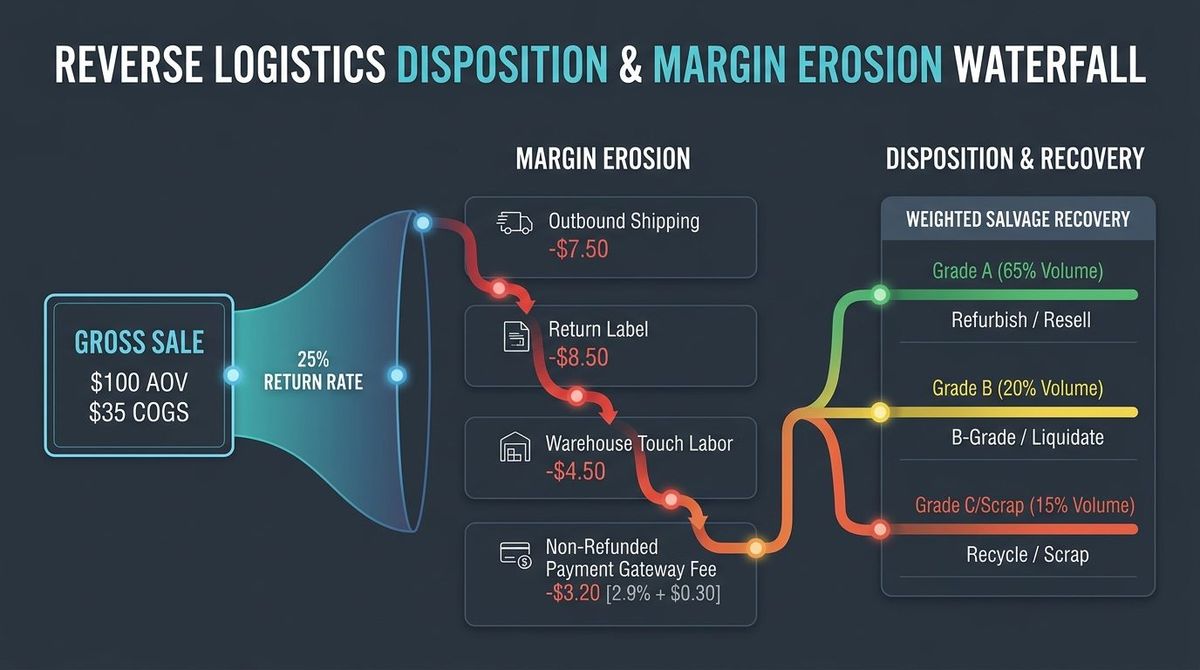
Formula 1: Retained Order Contribution \(G_{\text{kept}}\) vs Returned Order Cash Burn \(L_{\text{ret}}\)
To measure how returns impact your bottom line, you must separate what happens financially when a customer keeps an order versus when a customer returns an order. Let us define the unit variables for a single shipped order:
- \(P\) = Retail Selling Price / Average Order Value collected from the customer (e.g., \(P = \$100.00\)).
- \(C\) = Landed Cost of Goods Sold, including manufacturing, inbound ocean/air freight, and customs duty (e.g., \(C = \$35.00\)).
- \(S_{\text{out}}\) = Outbound fulfillment pick-pack-and-ship postage paid by the merchant (\(\$7.00\text{ to }\$7.50\)).
- \(S_{\text{ret}}\) = Prepaid return shipping label cost via USPS Ground Advantage, UPS, or FedEx (\(\$7.00\text{ to }\$7.50\)).
- \(f_{\text{pay}}\) = Non-refundable payment processor fee rate (\(2.9\% + \$0.30 = \$3.20\) on a \(\$100.00\) order via Stripe or Shopify Payments, which is never refunded when you issue a customer refund).
- \(L_{\text{3PL}}\) = Warehouse reverse-logistics touch labor fee to receive, open, inspect, steam, re-polybag, and restock the returned item (\(\$3.75\text{ to }\$4.50\)).
- \(w_{\text{dmg}}\) = Weighted inventory shrinkage and open-box write-down factor across 3PL inspection grades: as illustrated in Figure 1, typical apparel/consumer returns grade out at 65% Grade A (full restock at \(100\%\) of \(C\)), 20% Grade B (reconditioned/secondary markdown recovery), and 15% Grade C (stained, damaged, or unsellable write-off, yielding a \(w_{\text{dmg}} = 15\%\) or \(\$5.25\) inventory loss on \(\$35.00\) COGS).
- \(F_{\text{restock}}\) = Any return shipping deduction or restocking fee retained from the customer's refund (\(\$0.00\) under free returns).
When a customer keeps the order, your Retained Order Contribution \(G_{\text{kept}}\) is:
\[G_{\text{kept}} = P - C - S_{\text{out}} - \left( P \cdot f_{\text{pay}} + \$0.30 \right)\]However, when a customer returns the order for a full refund, you do not merely reset profit to zero. Even when the item is placed back into sellable inventory, you permanently burn outbound shipping, return label postage, 3PL restocking labor, the non-refundable \(\$3.20\) payment gateway fee, and the weighted Grade B/C damage write-down:
\[L_{\text{ret}} = S_{\text{out}} + S_{\text{ret}} + L_{\text{3PL}} + \left( P \cdot f_{\text{pay}} + \$0.30 \right) + \left( w_{\text{dmg}} \cdot C \right) - F_{\text{restock}}\]Formula 2: Blended Net Contribution \(G_{\text{net}}\) and Operating Profit Across Return Rate Tiers
Across a cohort of shipped orders with return rate \(r\) (expressed as a decimal, e.g., \(r = 0.15\) for 15%), a fraction \((1 - r)\) generates \(G_{\text{kept}}\) while a fraction \(r\) inflicts a direct cash loss of \(L_{\text{ret}}\). Combining both streams yields the Master E-Commerce Return Rate Margin Formula:
\[G_{\text{net}}(r) = (1 - r) \cdot G_{\text{kept}} - r \cdot L_{\text{ret}} = G_{\text{kept}} - r \cdot \left( G_{\text{kept}} + L_{\text{ret}} \right)\]Notice the algebraic structure when we expand \(G_{\text{net}}(r)\): every \(1\%\) increase in return rate \(r\) reduces your expected profit per shipped order by \(G_{\text{kept}} + L_{\text{ret}}\)! Let us evaluate our \(\$100.00\) benchmark order (\(P = \$100.00\), \(C = \$35.00\), \(S_{\text{out}} = \$7.00\), \(S_{\text{ret}} = \$7.00\text{ to }\$7.50\), \(L_{\text{3PL}} = \$3.75\text{ to }\$4.50\), gateway fee \(\$3.20\), and \(w_{\text{dmg}} = 15\%\) [\(\$5.25\) write-down]):
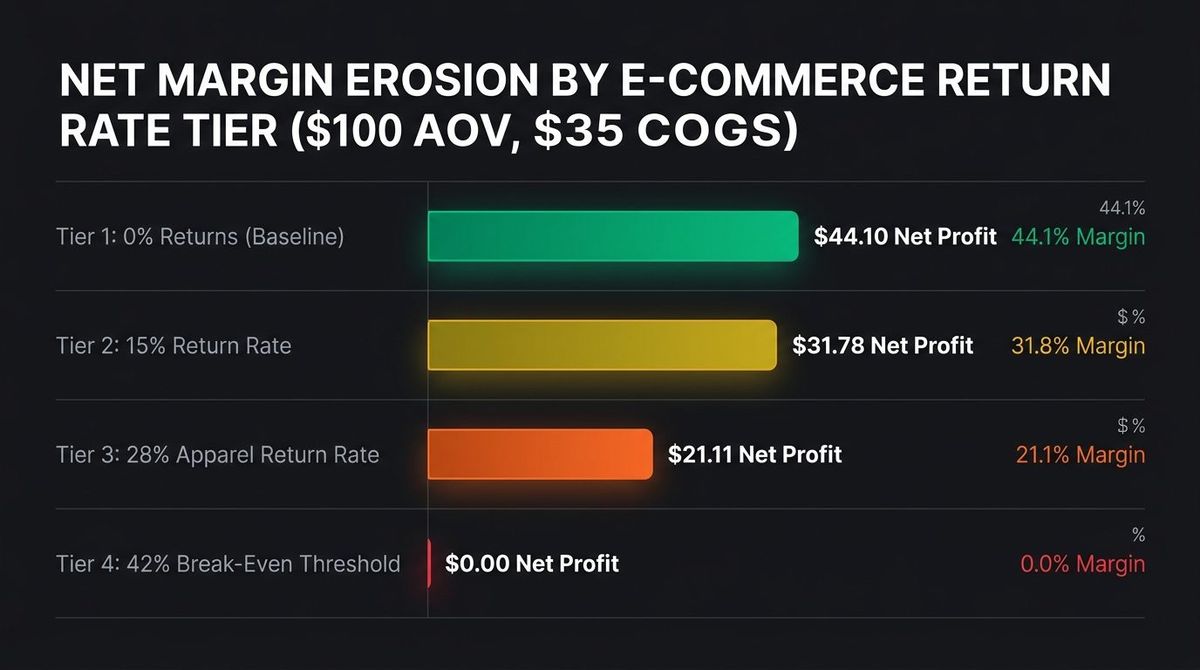
- Retained Order Gross Contribution (\(G_{\text{kept}}\)): \(\$100.00 - \$35.00 - \$7.00 - \$3.20 = \mathbf{\$54.80}\) (\(54.8\%\) gross contribution margin before fixed overhead, or $44.10 Net Operating Profit [44.1%] after allocating \(\$10.70/\text{order}\) in baseline store overhead/retention marketing as shown in Figure 2).
- Returned Order Out-of-Pocket Cash Burn (\(L_{\text{ret}}\)): \(\$7.00 + \$7.00 + \$3.75 + \$3.20 + \$5.25 = \mathbf{\$26.20}\) (\(\$27.45\) at \(\$7.50\) label + \(\$4.50\) 3PL touch labor) burned on every single return!
- Total Profit Swing per Returned Order (\(G_{\text{kept}} + L_{\text{ret}}\)): \(\$54.80 + \$26.20 = \mathbf{\$81.00}\) (\(\$82.15\) with full 3PL touch fees) lost relative to a kept order.
| Return Rate Tier (\(r\)) | Net Realized Revenue | Gross Contribution (\(G_{\text{net}}\)) | Reverse Logistics Burn (\(r \cdot L_{\text{ret}}\)) | Net Operating Profit (After $10.70 Overhead — Fig. 2) | Profit Erosion vs 0% Baseline |
|---|---|---|---|---|---|
| Tier 1: 0% Returns (\(r = 0.00\)) | $100.00 | +$54.80 (54.8%) | $0.00 | +$44.10 (44.1% Net Margin) | 0.0% (Baseline) |
| 5% Returns (\(r = 0.05\)) | $95.00 | +$50.75 (53.4%) | -$1.31 | +$40.00 (40.0% Net Margin) | -7.4% Gross / -9.3% Net |
| 10% Returns (\(r = 0.10\)) | $90.00 | +$46.70 (51.9%) | -$2.62 | +$35.89 (35.9% Net Margin) | -14.8% Gross / -18.6% Net |
| Tier 2: 15% Standard E-Com (\(r = 0.15\)) | $85.00 | +$42.65 (50.2%) | -$3.93 to -$4.12 | +$31.78 (31.8% Net Margin) | -22.2% Gross / -27.9% Net |
| 25% Apparel Returns (\(r = 0.25\)) | $75.00 | +$34.55 (46.1%) | -$6.55 | +$23.56 (23.6% Net Margin) | -37.0% Gross / -46.6% Net |
| Tier 3: 28% Apparel Benchmark (\(r = 0.28\)) | $72.00 | +$32.12 (44.6%) | -$7.34 to -$7.69 | +$21.11 (21.1% Net Margin) | -41.4% Gross / -52.1% Net |
| Tier 4: 42% Break-Even Threshold (\(r = 0.42\)) | $58.00 | +$20.78 (Pre-CAC) | -$11.00 to -$11.53 | $0.00 (0.0% Break-Even Floor) | -100.0% Net Profit Wiped Out |
Look closely at the Tier 2 (15% Return Rate) and Tier 3 (28% Apparel Return Rate) rows in the table above and in Figure 2 below: at a \(15\%\) return rate, net operating profit drops from \(\$44.10\) to \(\$31.78\) (\(-27.9\%\) profit lost); at the \(28\%\) apparel benchmark, net operating profit plunges to \(\$21.11\) (\(-52.1\%\) profit wiped out); and once returns reach the 42% Break-Even Threshold (with \(\$20.78\) acquisition/overhead load), your store generates $0.00 net profit on every shipped parcel!
Formula 3: Break-Even Return Rate Ceiling \(r_{\max}\) After Ad Spend (\(\text{CAC}\))
Every e-commerce CFO and media buyer needs to know the exact Break-Even Return Rate Ceiling \(r_{\max}\) above which a paid-acquisition order loses money. Setting \(G_{\text{net}}(r_{\max}) - \text{CAC} = 0\) and solving for \(r_{\max}\) gives:
\[r_{\max} = \frac{G_{\text{kept}} - \text{CAC}}{G_{\text{kept}} + L_{\text{ret}}}\]- Blended Store Break-Even (at \(\$20.78\) Blended Overhead/Ad Spend, Figure 2 Tier 4): \(r_{\max} = \frac{\$54.80 - \$20.78}{\$54.80 + \$26.20} = \frac{\$34.02}{\$81.00} = \mathbf{0.4200\ (42.0\%)}\).
- Cold Paid-Social Acquisition Break-Even (at \(\text{CAC} = \$32.00\) on Meta/TikTok Ads): \[r_{\max} = \frac{\$54.80 - \$32.00}{\$54.80 + \$26.20} = \frac{\$22.80}{\$81.00} = \mathbf{0.2815\ (28.15\%)}\] If your return rate on a cold-traffic apparel SKU crosses \(28.15\%\) (common when shoppers bracket-order two dress or footwear sizes), you lose money on every new customer acquired at a \(\$32.00\ \text{CAC}\)!
Formula 4: Restocking Fee and Size-Exchange Bonus Offset Math
As merchants discuss in r/shopify return-label fee case studies, two policy levers immediately compress \(L_{\text{ret}}\):
- Deducting an $8.00 Return Label Handling Fee (\(F_{\text{restock}} = \$8.00\)) on Cash Refunds (Waived for Exchanges/Store Credit): Deducting an \(\$8.00\) return label fee on cash refunds cuts \(L_{\text{ret}}\) from \(\$26.20\) down to \(\$18.20\)—recovering \(30.5\%\) of your reverse logistics cash burn while nudging \(35\%+\) of returning shoppers to select a free size exchange instead.
- Converting Refunds to Size Exchanges (\(G_{\text{exchange}}\)): When a customer exchanges a Medium for a Large rather than refunding, you incur the return label, 3PL touch labor, and replacement outbound postage (\(S_{\text{ret}} + L_{\text{3PL}} + S_{\text{reship}} \approx \$17.75\)), but you preserve the retained contribution \(G_{\text{kept}} = \$54.80\): \[G_{\text{exchange}} = G_{\text{kept}} - \left( S_{\text{ret}} + L_{\text{3PL}} + S_{\text{reship}} \right) = \$54.80 - \$17.75 = \mathbf{+\$37.05\text{ net profit}}\] Converting a refund into an exchange turns a \(-\$26.20\) cash loss into a \(+\$37.05\) profitable order—a \(+\$63.25\) bottom-line rescue!
Formula 5: The "Returnless Refund" Salvage Cutoff
As highlighted in r/FulfillmentByAmazon returnless resolution analyses, low-COGS accessories, cosmetics, and supplements often cost more to ship back and inspect than the recoverable inventory is worth. Program your returns portal (Loop, AfterShip, Redo) to trigger an automatic Returnless Refund whenever recoverable inventory value falls below reverse handling cost:
\[(1 - w_{\text{dmg}}) \cdot C < S_{\text{ret}} + L_{\text{3PL}} - F_{\text{restock}}\]Worked Example: Suppose you sell a \(\$34.00\) phone case or skincare item with a landed cost of \(C = \$5.50\) and an open-box disposal rate of \(w_{\text{dmg}} = 40\%\). Your recoverable inventory value is only \(\$5.50 \times (1 - 0.40) = \mathbf{\$3.30}\). If paying for a USPS return label (\(S_{\text{ret}} = \$5.80\)) plus 3PL inspection (\(L_{\text{3PL}} = \$3.50\)) costs \(\mathbf{\$9.30}\), requiring the customer to mail the item back burns \(\mathbf{\$6.00\text{ more cash}}\) than letting them keep it!
Frequently Asked Questions
What is the formula for net profit margin after e-commerce returns?
Net Contribution per Shipped Order is \(G_{\text{net}}(r) = (1 - r) \cdot G_{\text{kept}} - r \cdot L_{\text{ret}}\), where \(r\) is the decimal return rate, \(G_{\text{kept}} = P - C - S_{\text{out}} - (P \cdot f_{\text{pay}} + \$0.30)\) is profit on a kept order, and \(L_{\text{ret}} = S_{\text{out}} + S_{\text{ret}} + L_{\text{3PL}} + (P \cdot f_{\text{pay}} + \$0.30) + (w_{\text{dmg}} \cdot C) - F_{\text{restock}}\) is the out-of-pocket cash loss on a returned order.
Do Shopify Payments, Stripe, and PayPal refund processing fees when a customer returns an item?
No. Standard commercial payment processors (Stripe, Shopify Payments, PayPal) do not refund the original \(2.9\% + \$0.30\) transaction fee when you issue a customer refund. On a \(\$100.00\) order, that \(\$3.20\) processing fee (\(\$3.78\) on a \(\$120.00\) order) becomes a permanent sunk loss on every returned parcel.
How do I calculate the Break-Even Return Rate \(r_{\max}\) for a product?
After accounting for customer acquisition cost (\(\text{CAC}\)) or fixed order overhead, your maximum break-even return rate is \(r_{\max} = \frac{G_{\text{kept}} - \text{CAC}}{G_{\text{kept}} + L_{\text{ret}}}\). For a \(\$100.00\) order with \(G_{\text{kept}} = \$54.80\) and \(L_{\text{ret}} = \$26.20\), the break-even return rate is \(28.15\%\) at a \(\$32.00\ \text{CAC}\), or \(42.0\%\) at a \(\$20.78\) blended overhead allocation.
When should an e-commerce store use a "Keep the Item" (Returnless Refund) policy?
Trigger a returnless refund or photo-verified exchange whenever the net recoverable inventory value of the item is less than the reverse logistics cost: \((1 - w_{\text{dmg}}) \cdot C < S_{\text{ret}} + L_{\text{3PL}}\). For example, if a product has an \(\$8.00\) landed COGS with \(25\%\) open-box damage (\(\$6.00\) recoverable value), but return postage and 3PL restocking cost \(\$11.50\), shipping it back loses \(\$5.50\) more than letting the customer keep or donate it.
Run the Interactive Calculator: Use our Retail Margin Calculator to model your exact SKU return rate, 3PL reverse logistics fees, and break-even ROAS in real time.