The Master Margin vs Markup Formula Guide: Essential Retail Pricing and Profit Calculations
Confusing gross margin with markup is one of the most frequent financial mistakes made by independent retailers and e-commerce store owners. Adding a 25% markup to a $100 item results in a $125 retail price—but delivers only a 20% gross margin, quietly draining expected profit and warping cash flow forecasts.
Key Takeaways: - Markup vs. Margin Benchmark: Markup measures profit relative to wholesale cost, whereas margin measures profit relative to retail selling price. - Margin Can Never Reach 100%: Because cost of goods sold (COGS) is greater than zero, gross profit margin is mathematically capped below 100%, while markup scales infinitely. - The Pricing Formula Rule: Always calculate retail selling price by dividing cost by
(1 - Target Margin %)rather than multiplying cost by markup percentage.
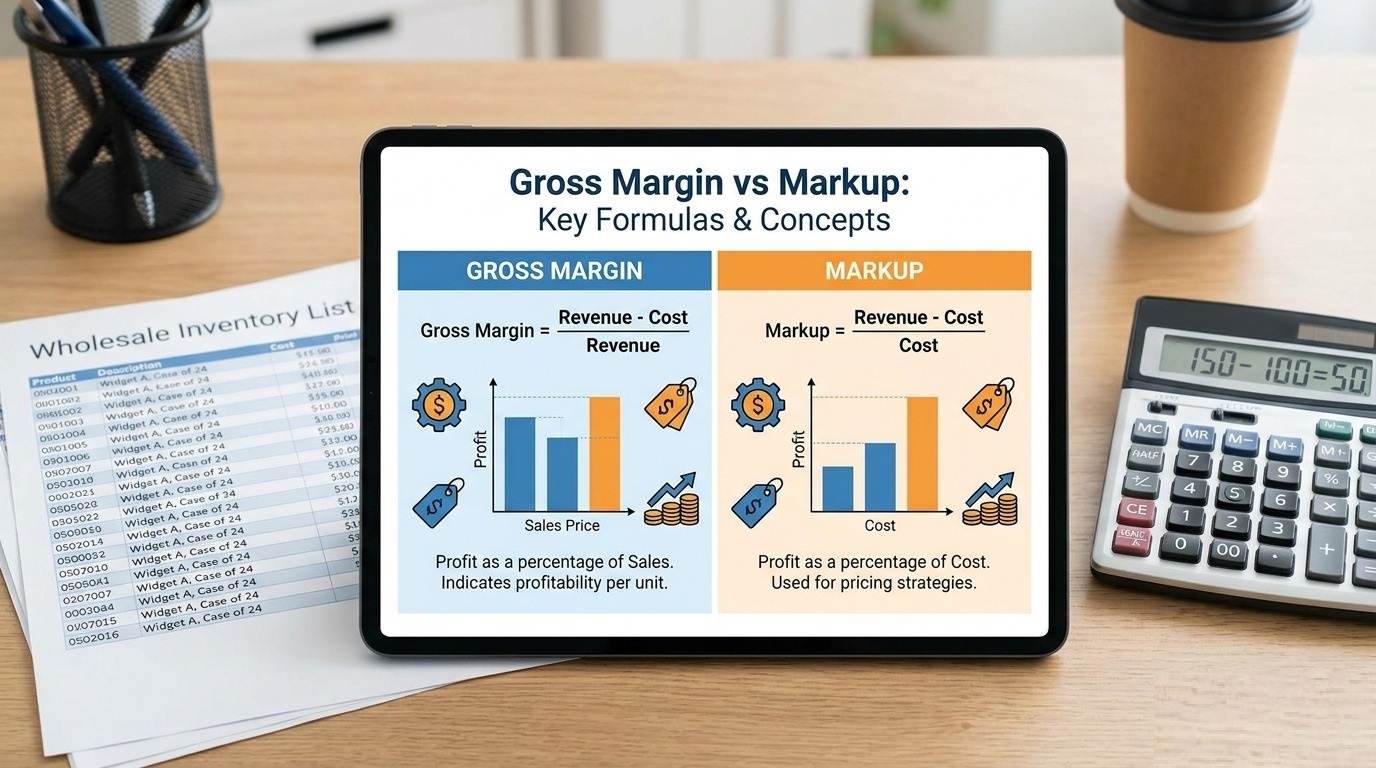
The Core Formulas: Margin vs. Markup Defined
To maintain sustainable profitability across your inventory catalog, you must distinguish between your cost basis and your final revenue. Both metrics evaluate gross profit, but they use entirely different denominators.
Here are the master formulas used by retail financial analysts and inventory managers:
Master Formula & Quick Conversion Box: $$\text{Gross Margin (\%)} = \left( \frac{\text{Selling Price} -\text{COGS}}{\text{Selling Price}} \right) \times 100$$
$$\text{Markup (\%)} = \left( \frac{\text{Selling Price} -\text{COGS}}{\text{COGS}} \right) \times 100$$
Conversion Shortcut (Price for Target Margin): $$\text{Target Retail Price} = \frac{\text{COGS}}{1 - \left( \frac{\text{Desired Margin \%}}{100} \right)}$$
Remember this critical rule of thumb: Markup is a percentage of cost; Margin is a percentage of selling price.
Understanding this relationship is crucial when setting price points for new inventory lines or reviewing commercial guidance from organizations like the U.S. Small Business Administration.
Step-by-Step Numerical Walkthrough: The $50 Wholesale Item Scenario
To visualize how confusing these metrics impacts your bottom line, consider a boutique store purchasing a wholesale item for $50.00. The owner wants to achieve a "30% profit," but the calculation method changes everything.
Scenario A: Applying 30% Markup
The retailer multiplies cost by 1.30: - Selling Price: $\$50.00 imes 1.30 = \$65.00$ - Gross Profit: $\$65.00 - \$50.00 = \$15.00$ - Actual Gross Margin: $ rac{\$15.00}{\$65.00} = 23.08\%$
Scenario B: Targeting 30% True Gross Margin
The retailer applies the conversion formula dividing cost by $(1 - 0.30)$: - Selling Price: $ rac{\$50.00}{0.70} = \$71.43$ - Gross Profit: $\$71.43 - \$50.00 = \$21.43$ - Actual Gross Margin: $ rac{\$21.43}{\$71.43} = 30.00\%$
By mistakenly applying a 30% markup instead of targeting a 30% true margin, the retailer loses $6.43 in revenue per unit sold. On a small run of 500 units, that single error creates a $3,215.00 profit shortfall!
Margin vs. Markup Conversion Table
Use this quick-reference table to convert between cost markup percentages and true gross profit margins instantly:
| Cost Markup (%) | Gross Margin (%) | Formula Multiplier on COGS | Effective Profit Outcome |
|---|---|---|---|
| 15.0% | 13.0% | $1.15 imes ext{COGS}$ | Slim margin for high-turnover grocery/commodities |
| 25.0% | 20.0% | $1.25 imes ext{COGS}$ | Standard clearance or discount pricing |
| 33.3% | 25.0% | $1.33 imes ext{COGS}$ | Modest retail markup for electronics |
| 50.0% | 33.3% | $1.50 imes ext{COGS}$ | Typical general retail baseline |
| 100.0% (Keystone) | 50.0% | $2.00 imes ext{COGS}$ | Standard apparel and specialty gift retail |

Hidden Business Pitfalls That Eat Your Margin
Even when retail prices are calculated accurately, hidden operational overhead can rapidly erode expected profit margins.
1. Discount Erosion
If an item has a 20% gross margin ($100 retail, $80 COGS, $20 profit) and you run a "20% off" storewide sale, your new retail price is $80. Your gross profit drops from $20 to $0.00, completely wiping out your margin!
2. Payment Processor & Shipping Fees
Standard payment gateways charge 2.9% + $0.30 per transaction. On a $50 sale with an $11 margin, processor fees ($1.75) absorb 16% of your net profit before accounting for shipping or packaging costs.
Pro Tip / Till Trainer: If managing register staff or point-of-sale training, pair your retail pricing strategy with Till Trainer to streamline POS cash handling, drawer auditing, and register reconciliation routines.
Actionable Retail Pricing Checklist
Ensure every item on your store shelf or e-commerce site generates genuine profit with this checklist:
- Confirm whether supplier price sheets list MSRP, wholesale cost, or suggested markup.
- Calculate retail price using
COGS / (1 - Target Margin %). - Factor in transaction fees (2.9% + $0.30) into your base cost structure.
- Establish maximum discount thresholds so storewide promotions never drop net margin below zero.
- Audit top-selling SKUs quarterly against updated shipping rates and COGS increases.
Free Retail Margin Calculator Tool
Avoid pricing errors before finalizing your retail inventory. Plug your wholesale cost into our free Retail Margin Calculator above to automatically toggle between target margin and markup in real time.
Frequently Asked Questions (FAQ)
Can profit margin ever be greater than 100%?
No, gross profit margin can never equal or exceed 100%. Because gross margin is calculated as (Revenue - COGS) / Revenue, and COGS is always greater than zero in commercial retail, profit is always strictly less than revenue. Markup, however, can easily exceed 100% (for example, a 200% markup on a $10 item results in a $30 price and a 66.7% margin).
What is keystone pricing in retail?
Keystone pricing is a classic retail rule of thumb where an item is priced at exactly double its wholesale cost (a 100% markup). Applying keystone pricing to a $25 wholesale product sets the retail price at $50, which yields a clean 50% gross profit margin.
How do shipping and credit card processing fees impact gross margin?
Shipping and payment processing fees reduce your net margin by adding non-product costs to each sale. To protect your target gross margin, treat credit card processing (typically 2.5% to 3.5%) and outbound shipping absorption as part of your total cost of goods sold before calculating final retail price points.