Retail Product Bundle Kitting and Cross-Elasticity Blended Margin Formula: 6 Profit Audit Rules
Bundling a high-velocity, lower-margin anchor product with one or two high-margin accessories is one of the fastest ways to expand Average Order Value (\(\text{AOV}\)) and clear slow-moving inventory without eroding brand equity through storewide clearance sales. However, many retail buyers and e-commerce merchandisers miscalculate bundle profitability by simply averaging the percentage margins of the individual SKUs or forgetting to deduct physical kitting labor, custom gift-box packaging, and full-price cannibalization. In this retail bundle blended margin formula guide, we derive the exact weighted COGS equations, cannibalization break-even volume thresholds, and POS terminal governance rules required to protect net contribution dollars.
Why does a naive arithmetic average of SKU margins fail? Because a \(30\%\) gross margin on a $100 anchor item ($30 profit) paired with an \(80\%\) gross margin on a $15 accessory ($12 profit) does not yield a \(55\%\) margin—the true unweighted pre-discount margin is \(\$42 / \$115 = 36.52\%\) before any bundle discount or kitting cost is applied! You can model multi-SKU blended margins and promotional markdowns instantaneously using our interactive Retail Margin & Markup Calculator.
Quick Answer — Retail Bundle Blended Margin Equations:
- Net Bundle Selling Price (\(P_{\text{bundle}}\)): \(P_{\text{bundle}} = \left(1 - d_{\text{bundle}}\right) \sum_{i=1}^{n} q_i P_i\), where \(d_{\text{bundle}}\) is the promotional bundle discount rate.
- Fully-Burdened Bundle COGS (\(C_{\text{bundle}}\)): \(C_{\text{bundle}} = \sum_{i=1}^{n} q_i C_i + C_{\text{kitting}} + C_{\text{pkg}}\), including assembly labor and custom outer packaging.
- Blended Gross Margin % (\(\text{GM\%}_{\text{bundle}}\)): \(\text{GM\%}_{\text{bundle}} = \frac{P_{\text{bundle}} - C_{\text{bundle}}}{P_{\text{bundle}}} \times 100\).
- Golden Merchandising Rule: Always pair a price-elastic traffic driver (\(30\text{–}38\%\) IMU) with complementary high-margin consumables or accessories (\(68\text{–}80\%\) IMU) so gross profit dollars per transaction (\(\text{GP\$}_{\text{bundle}}\)) strictly exceed standalone anchor profit (\(\text{GP\$}_{\text{anchor}}\)).
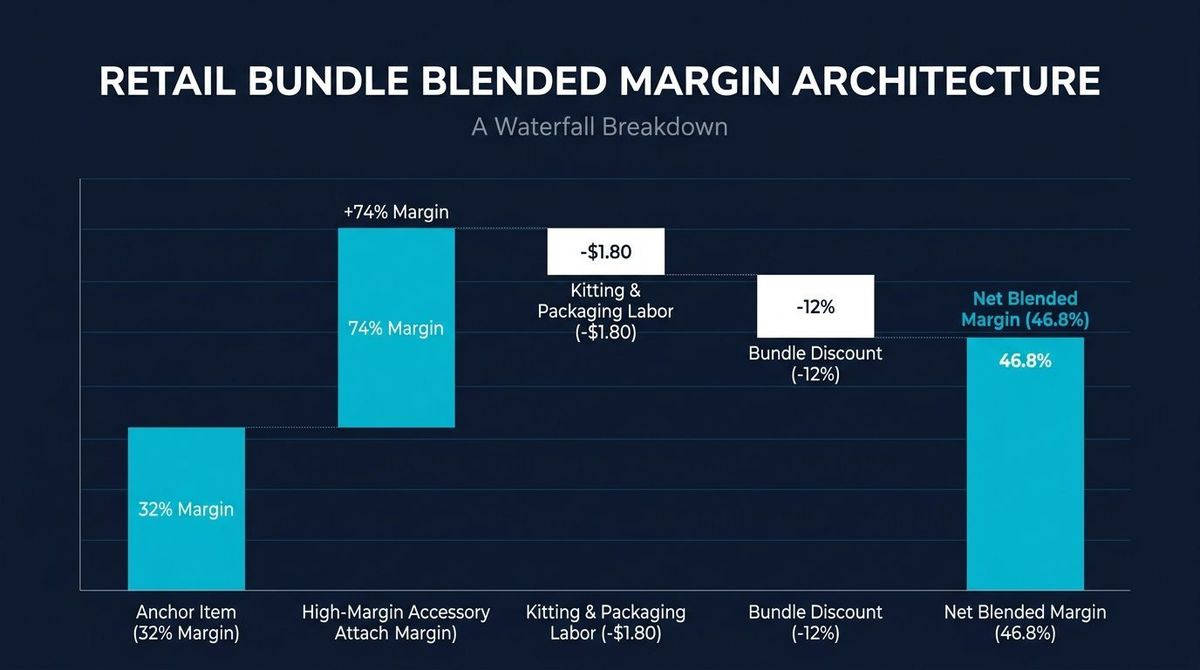
1. The Weighted SKU Aggregation & Kitting Deduction Formula
Consider a retail kit composed of \(n\) distinct child SKUs, where item \(i\) has standalone retail price \(P_i\), landed unit cost \(C_i\), and quantity \(q_i\) inside the bundle. When the retailer offers a promotional bundle discount percentage \(d_{\text{bundle}}\) off the sum of standalone retail prices and incurs physical kitting labor \(C_{\text{kitting}}\) plus outer box/insert packaging cost \(C_{\text{pkg}}\), the exact blended gross profit dollars (\(\text{GP\$}_{\text{bundle}}\)) and blended gross margin percentage (\(\text{GM\%}_{\text{bundle}}\)) are governed by:
Critically, for a bundle to be accretive to store contribution profit on every single basket where a shopper would have otherwise purchased only the standalone anchor item (Item 1), the bundle must satisfy the Incremental Contribution Inequality:
Rearranging this inequality reveals the Maximum Allowable Bundle Discount (\(d_{\text{max}}\)) before a bundle starts losing money relative to a standalone anchor sale:
2. Worked Retail Merchandising Audit: 3-SKU Specialty Coffee Bundle
Suppose a specialty kitchen retailer creates a "Barista Pour-Over Starter Kit" combining three SKUs:
- SKU 1 (Anchor — Electric Gooseneck Kettle): Standalone Price \(P_1 = \$90.00\), Landed Cost \(C_1 = \$61.20\) (\(\text{GM\%}_1 = 32.0\%\), \(\text{GP\$}_1 = \$28.80\)), \(q_1 = 1\).
- SKU 2 (Attach — Ceramic Dripper Carafe): Standalone Price \(P_2 = \$35.00\), Landed Cost \(C_2 = \$10.50\) (\(\text{GM\%}_2 = 70.0\%\), \(\text{GP\$}_2 = \$24.50\)), \(q_2 = 1\).
- SKU 3 (Consumable — 200-Pack Unbleached Filters): Standalone Price \(P_3 = \$15.00\), Landed Cost \(C_3 = \$2.25\) (\(\text{GM\%}_3 = 85.0\%\), \(\text{GP\$}_3 = \$12.75\)), \(q_3 = 1\).
- Kitting & Packaging Overhead: Warehouse assembly labor \(C_{\text{kitting}} = \$0.75\) + printed gift sleeve \(C_{\text{pkg}} = \$1.05\) (\(\$1.80\) total kitting cost).
- Promotional Bundle Discount: \(d_{\text{bundle}} = 12.0\%\) off combined standalone price.
Let us audit the exact bundle math step by step:
- Combined Standalone Value & Net Bundle Price: \[ P_{\text{list\_sum}} = \$90.00 + \$35.00 + \$15.00 = \$140.00 \implies P_{\text{bundle}} = \$140.00 \times (1 - 0.12) = \mathbf{\$123.20} \]
- Fully-Burdened Bundle COGS: \[ C_{\text{bundle}} = (\$61.20 + \$10.50 + \$2.25) + \$1.80 = \$73.95 + \$1.80 = \mathbf{\$75.75} \]
- Net Bundle Gross Profit Dollars & Blended Gross Margin %: \[ \text{GP\$}_{\text{bundle}} = \$123.20 - \$75.75 = \mathbf{\$47.45\,\text{profit/kit}}, \qquad \text{GM\%}_{\text{bundle}} = \frac{\$47.45}{\$123.20} = \mathbf{38.51\%} \]
Compare the outcomes: when a customer buys the bundle instead of just the $90 kettle, store gross profit jumps from $28.80 to $47.45 per transaction (+\$18.65 / +64.8% profit dollar lift), and blended margin percentage expands from \(32.0\%\) to \(38.51\%\) (+651 bps) while the customer saves $16.80!
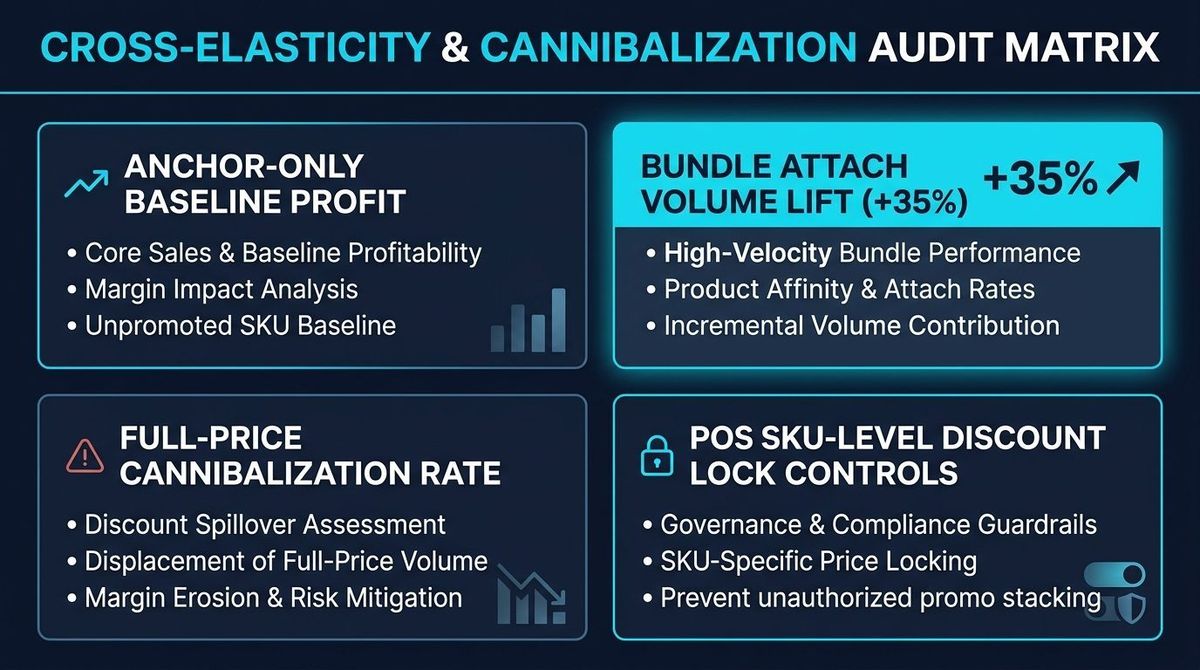
3. Cross-Elasticity & Cannibalization Break-Even Volume Lift Math
What if a portion of your customers (\(\alpha_{\text{cann}}\), the full-price multi-item cannibalization rate) were already buying all three items together at full standalone price (\(\$140.00\), generating \(\text{GP\$}_{\text{full}} = \$140.00 - \$73.95 = \$66.05\) profit)? Every cannibalized multi-item buyer costs the store \(\Delta \text{GP\$}_{\text{cann}} = \$66.05 - \$47.45 = \$18.60\) in foregone margin, whereas every upgraded anchor-only buyer adds \(\Delta \text{GP\$}_{\text{lift}} = \$47.45 - \$28.80 = +\$18.65\) in incremental profit. The bundle is net-profitable across the category whenever the ratio of upgraded anchor buyers (\(N_{\text{upgrade}}\)) to cannibalized full-basket buyers (\(N_{\text{cann}}\)) exceeds:
In our Barista Kit example, \(\frac{\$18.60}{\$18.65} = 0.997\): as long as at least 1 anchor-only shopper upgrades to the bundle for every 1 shopper who would have bought all three items separately at full price, the promotion increases total store net profit.
4. Multi-Tier Bundle Discount Sensitivity Table ($140 List Value Kit)
| Bundle Discount (\(d_{\text{bundle}}\)) | Bundle Retail Price (\(P_{\text{bundle}}\)) | Loaded Bundle COGS (\(C_{\text{bundle}}\)) | Net Gross Profit (\(\text{GP\$}_{\text{bundle}}\)) | Blended Margin (\(\text{GM\%}_{\text{bundle}}\)) | Profit Lift vs. Anchor (\(\$28.80\)) |
|---|---|---|---|---|---|
| 0% (Full Price Kit) | $140.00 | $75.75 | $64.25 | \(45.89\%\) | +\$35.45 (+123.1%) |
| 10% Bundle Promo | $126.00 | $75.75 | $50.25 | \(39.88\%\) | +\$21.45 (+74.5%) |
| 12% Bundle Promo | $123.20 | $75.75 | $47.45 | \(38.51\%\) | +\$18.65 (+64.8%) |
| 15% Bundle Promo | $119.00 | $75.75 | $43.25 | \(36.34\%\) | +\$14.45 (+50.2%) |
| 20% Bundle Promo | $112.00 | $75.75 | $36.25 | \(32.37\%\) | +\$7.45 (+25.9%) |
| 25.3% (\(d_{\text{max}}\) Floor) | $104.55 | $75.75 | $28.80 | \(27.55\%\) | \$0.00 (Break-Even Floor) |
Notice that \(d_{\text{max}} = 25.3\%\) ($104.55 bundle price) is the absolute mathematical ceiling: discounting the bundle beyond \(25.3\%\) causes the store to earn fewer gross profit dollars on the 3-item kit than on the standalone $90 kettle!
5. POS Bundle SKU Governance & Till Discount-Stacking Controls
Even a mathematically sound bundle can turn margin-negative at the register if cashiers manually key in line-item overrides or allow customers to stack a \(15\%\) VIP coupon on top of an already-discounted \(15\%\) bundle SKU. Implement these four POS governance controls:
- Create a Dedicated Virtual/Physical Parent Bundle Barcode (`BOM-SKU`): Never instruct cashiers to scan three separate items and apply a manual "Bundle Override" discount at the register, which obscures shrinkage audits and enables sweethearting.
- Enable `Promo-Exclude` / `No-Stacking` Flags on Parent Bundle SKUs: Lock the parent bundle barcode in your ERP/POS price book so storewide percentage-off coupons cannot stack on top of the bundle discount.
- Allocate Bundle Revenue Proportionally by Standalone Price for Vendor Co-Op & Commission: In your accounting ledger, allocate net bundle revenue across child SKUs using \(w_i = \frac{q_i P_i}{\sum q_j P_j}\) so category GMROI and inventory valuation remain accurate.
- Train Cashiers on Bundle Return Partial-Refund Rules: If a customer buys the 3-piece kit for $123.20 and attempts to return only the $90 kettle for a full $90 refund, the POS receipt must enforce a prorated return credit (\(\$123.20 - \$35.00 - \$15.00 = \$73.20\)) so the customer cannot keep the accessories for less than cost.
To train your retail store associates and shift supervisors on POS bundle scanning, coupon-stacking prevention, and partial-return proration rules, run your team through interactive register scenarios on Till Trainer alongside our margin calculation suite.
Frequently Asked Questions
Should pre-assembled gift bundles be tracked as a separate physical SKU or a virtual BOM kit?
If your warehouse pre-packs the items into a sealed gift sleeve (`C_kitting` incurred upfront), assign a dedicated physical SKU and deduct child inventory at the moment of kitting assembly. If cashiers or pick-packers pull the items from standard shelf stock at checkout, use a virtual Bill-of-Materials (`BOM`) kit SKU that automatically deducts 1 unit of each child SKU upon sale.
How do I account for different sales tax or VAT rates inside a mixed product bundle?
When bundling a zero-rated or reduced-tax item (such as specialty whole-bean coffee or children's apparel) with a standard-tax hardline item (such as a ceramic mug or kettle), configure your POS to prorate the bundle price across the child SKUs' tax codes by standalone price weight (\(w_i\)) so you never over-remit VAT/sales tax on the tax-exempt component.
Why does bundling slow-moving seasonal stock with a best-seller improve GMROI?
Attaching slow-moving high-IMU accessories to a high-turn anchor SKU converts dead working capital into cash without advertising a brand-damaging 50% clearance markdown, simultaneously boosting inventory turnover and Gross Margin Return on Inventory Investment (GMROI).
Audit Your Multi-SKU Bundle Margins & Train Your POS Staff
Before launching your next promotional kit or holiday gift bundle, test your exact SKU costs, kitting labor, and discount tiers in our free Retail Margin & Markup Calculator, and equip your front-line cashiers with register profit-protection skills using Till Trainer.