Retail Dimensional Weight (DIM Divisor 139 vs 166) Packaging Cube & Outbound Freight Margin Erosion Formula: Box Right-Sizing ROI Calculator
Executive Fulfillment Margin Summary: Under 2026 carrier tariff rules, UPS Daily Rates and FedEx apply a Dimensional Weight (DIM) divisor of \( D = 139\text{ in}^3/\text{lb} \) across all parcel sizes, while USPS Ground Advantage / Priority Mail and UPS Retail Rates apply \( D = 166\text{ in}^3/\text{lb} \) (with USPS exempting cartons \( \le 1{,}728\text{ in}^3 \)). Shipping a \( 4.0\text{ lb} \) retail SKU inside a standard \( 14 \times 12 \times 10\text{ in} \) (\( 1{,}680\text{ in}^3 \)) carton triggers a \( 13\text{ lb} \) billable DIM weight under the \( 139 \) divisor—eroding gross profit by \( \$4.18 \) per order (\( 8.36\% \) margin loss on a \( \$50 \) item). Right-sizing box height by just \( 2.0\text{ inches} \) to \( 14 \times 12 \times 8\text{ in} \) (\( 1{,}344\text{ in}^3 \)) drops billable weight to \( 10\text{ lb} \) and recovers \( \$2{,}760/\text{month} \) across \( 2{,}000 \) shipments.
How Does Dimensional Weight Billing Silently Destroy E-Commerce Gross Margins?
Retailers and omnichannel brands frequently model unit gross margin using factory landed cost plus a flat-rate outbound shipping estimate based on the product's physical scale weight. However, parcel carriers and 3PL fulfillment networks (UPS, FedEx, DHL, and Amazon FBA) bill outbound freight on Chargeable Weight (\( W_{\text{bill}} \))—defined as the greater of actual gross scale weight (\( W_{\text{actual}} \)) or volumetric Dimensional Weight (\( W_{\text{DIM}} \)), rounded up to the next whole pound.
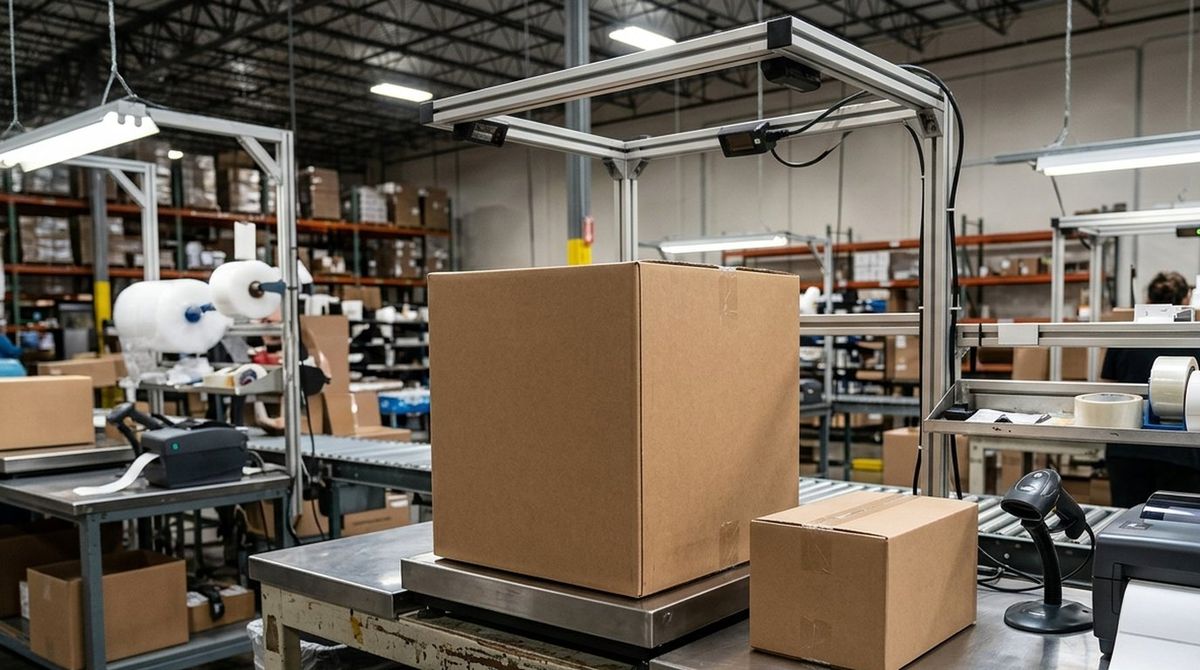
Furthermore, carrier laser-tunnel dimensioners measure the outermost bulge of the corrugated shipping carton after transit vibration, rounding any fractional measurement of \( 0.50\text{ in} \) or greater up to the next whole inch. If a warehouse packer grabs a stock \( 14 \times 12 \times 10\text{ in} \) box to ship a lightweight \( 4.0\text{ lb} \) apparel bundle or small appliance, you are billed for \( 13\text{ lb} \) of "air"—wiping out nearly a third of your net contribution margin. You can audit your exact SKU packaging cube and carrier divisor break-even using the interactive calculator below or at the Retail Margin Calculator.
What Is the Dimensional Weight (139 vs. 166 Divisor) & Margin Erosion Formula?
Given exterior carton length \( L \), width \( W \), and height \( H \) (in inches) and carrier DIM divisor \( D \in \{139, 166\} \), the billable shipping weight \( W_{\text{bill}} \) (in whole pounds) and the resulting DIM Surcharge Margin Erosion \( \Delta GM_{\text{DIM}} \) on a retail price \( P_{\text{retail}} \) are defined by:
\[ V_{\text{cube}} = L \times W \times H \quad \implies \quad W_{\text{DIM}} = \left\lceil \frac{V_{\text{cube}}}{D} \right\rceil \] \[ W_{\text{bill}} = \max\left( \lceil W_{\text{actual}} \rceil, \, W_{\text{DIM}} \right) \] \[ \Delta C_{\text{freight}} = \left( W_{\text{bill}} - \lceil W_{\text{actual}} \rceil \right) \cdot r_{\text{lb}} \quad \implies \quad \Delta GM_{\%} = -\frac{\Delta C_{\text{freight}}}{P_{\text{retail}}} \times 100\% \]Where \( r_{\text{lb}} \approx \$0.46/\text{lb} \) (typically \( \$0.38 \) to \( \$0.58/\text{lb} \) across Zones 4–6) is the incremental carrier rate per additional billed pound above the base weight tier. Conversely, to hit a target billable weight ceiling \( W_{\text{target}} \), the maximum allowable cubic volume is \( V_{\text{max}} = W_{\text{target}} \times D \).
Worked Carton Audit (\( 14 \times 12 \times 10\text{ in} \) Box, \( W_{\text{actual}} = 4.0\text{ lb} \), \( P_{\text{retail}} = \$50.00 \)):
- Cubic Volume: \( V_{\text{cube}} = 14 \times 12 \times 10 = 1{,}680\text{ in}^3 \) (\( 0.972\text{ ft}^3 \)).
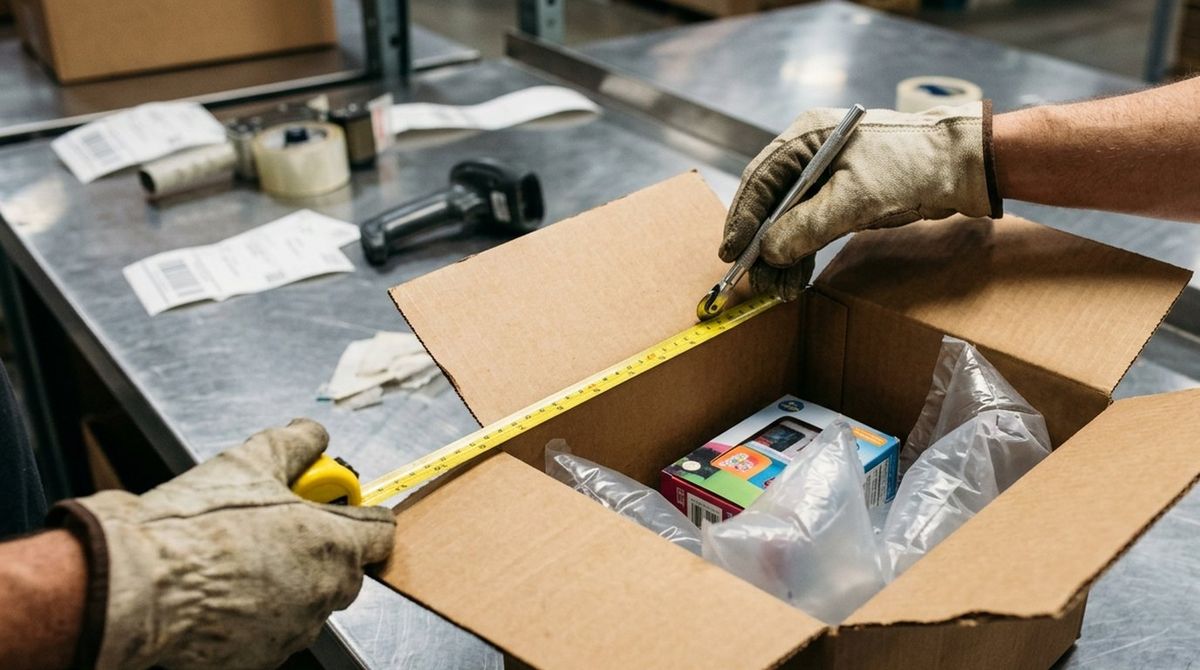
- UPS Daily / FedEx / FBA (\( D = 139 \)): \( W_{\text{DIM}} = \lceil 1{,}680 / 139 \rceil = \lceil 12.086 \rceil = 13\text{ lb} \). Because \( 12.086\text{ lb} \) is just \( 0.086\text{ lb} \) (\( 12\text{ in}^3 \)) over the \( 12\text{ lb} \) boundary (\( 12 \times 139 = 1{,}668\text{ in}^3 \)), it rounds up to a full \( 13\text{ lb} \)—charging you for \( 9 \) phantom pounds (\( 9 \times \$0.46 = \$4.14 \) surcharge per unit)!
- UPS Retail Rate (\( D = 166 \)): \( W_{\text{DIM}} = \lceil 1{,}680 / 166 \rceil = \lceil 10.12 \rceil = 11\text{ lb} \) (\( 7 \) phantom pounds = \( \$3.22 \) surcharge).
- USPS Ground Advantage (\( D = 166 \) only above \( 1{,}728\text{ in}^3 \)): Because \( 1{,}680\text{ in}^3 \le 1{,}728\text{ in}^3 \) (\( 1.0\text{ ft}^3 \)), USPS exempts the package from DIM weight entirely and bills strictly on actual weight: \( W_{\text{bill}} = 4\text{ lb} \) (\( \$0.00 \) DIM penalty!).
| Carton Dimensions (\( L \times W \times H \)) | Cubic Volume (\( V_{\text{cube}} \)) | UPS/FedEx \( D=139 \) Billed Weight | USPS \( D=166 \) (\(>1{,}728\text{ in}^3\)) | Net Gross Margin on \( \$50 \) SKU (\( \$22 \) COGS) |
|---|---|---|---|---|
| Stock \( 14 \times 12 \times 10\text{ in} \) | \( 1{,}680\text{ in}^3 \) | \( 13\text{ lb} \) (\( +\$4.14 \) DIM fee) | \( 4\text{ lb} \) (Exempt \(\le 1\text{ ft}^3\)) | \( 34.92\% \) (\( \$17.46 \) net GM on UPS/FedEx) |
| Trimmed \( 14 \times 12 \times 9.8\text{ in} \) | \( 1{,}646\text{ in}^3 \) | \( 12\text{ lb} \) (\( +\$3.68 \) DIM fee) | \( 4\text{ lb} \) (Exempt \(\le 1\text{ ft}^3\)) | \( 35.84\% \) (\( +\$0.46/\text{unit} \) saved via 1-lb drop) |
| Multi-Depth \( 14 \times 12 \times 8\text{ in} \) | \( 1{,}344\text{ in}^3 \) | \( 10\text{ lb} \) (\( +\$2.76 \) DIM fee) | \( 4\text{ lb} \) (Exempt \(\le 1\text{ ft}^3\)) | \( 37.68\% \) (\( +\$1.38/\text{unit} \) saved vs 10" box) |
| Right-Sized \( 11 \times 9 \times 6\text{ in} \) | \( 594\text{ in}^3 \) | \( 5\text{ lb} \) (\( +\$0.46 \) DIM fee) | \( 4\text{ lb} \) (Actual weight) | \( 42.28\% \) (\( +\$3.68/\text{unit} \) margin recovery) |
Why the 1,728 Cubic-Inch (1 Cubic Foot) USPS Threshold Is a Multi-Carrier Arbitrage
When routing orders through multi-carrier shipping software, the \( 1{,}728\text{ in}^3 \) (\( 12 \times 12 \times 12\text{ in} \)) threshold creates an immediate rate-shopping arbitrage. Any lightweight order between \( 700\text{ in}^3 \) and \( 1{,}720\text{ in}^3 \) weighing under \( 5\text{ lb} \) is heavily penalized by UPS and FedEx's universal \( 139 \) divisor (\( 6\text{ lb} \) to \( 13\text{ lb} \) billed weight), whereas USPS Ground Advantage bills the exact same carton at its true \( 2\text{ lb} \) to \( 5\text{ lb} \) scale weight as long as exterior bulge never pushes total volume over \( 1{,}728\text{ in}^3 \).
Interactive Dimensional Weight (139 vs. 166) & Margin Erosion Calculator
Retail Carton DIM Weight & Profit Margin Recovery Calculator
Enter your carton dimensions, actual scale weight, retail price, and monthly order volume to audit DIM surcharges across divisors 139 and 166:
UPS/FedEx (Divisor 139): 13 lb billed (+$4.14/order DIM surcharge = $8280/mo)
UPS Retail (Divisor 166): 11 lb billed | USPS Ground Advantage: 4 lb billed
3-Tier Warehouse Dimensioning & Fulfillment Hardware (\( \ge \$120 \) Floor)
| Tier Level | Recommended Logistics Hardware | Retail Price | Fulfillment Margin Application |
|---|---|---|---|
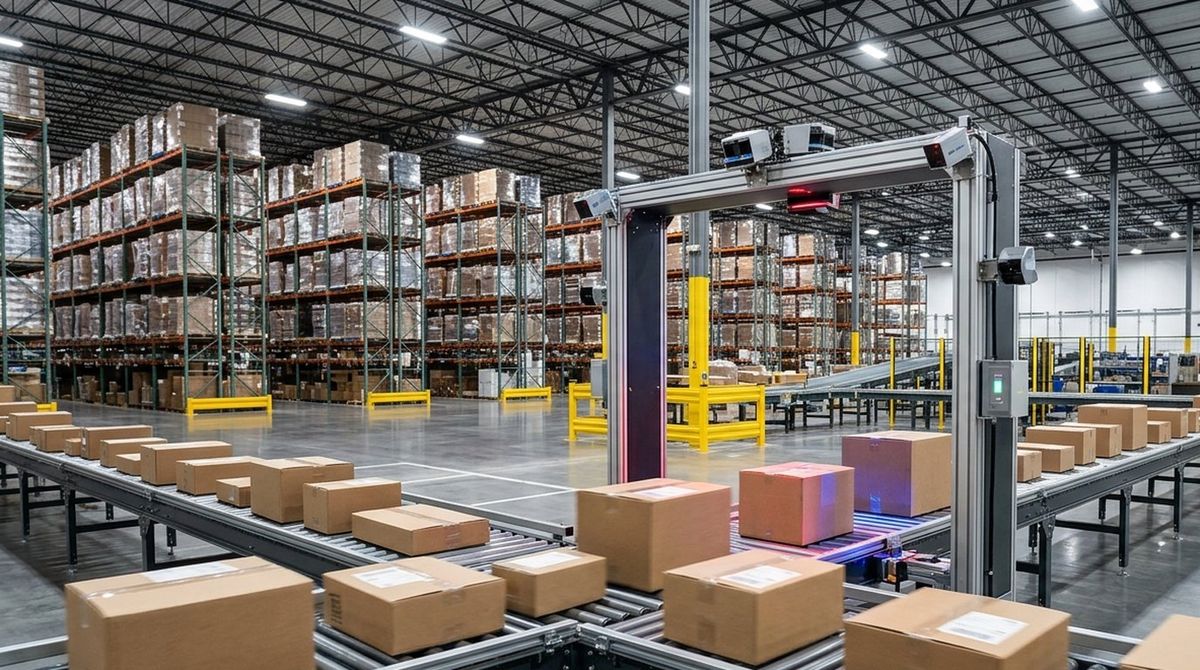
| Tier 1: NTEP Certified Dimensioner | CubiScan 100 Static Parcel Dimensioning System | \( \$6{,}495 \) | Ultrasonic/infrared \( 0.1\text{ in} \) master SKU dimensioning and weight capture for WMS/ERP carton optimization. |
| Tier 2: Legal-for-Trade Bench Scale | Mettler Toledo BC-60 USB/Ethernet Shipping Scale | \( \$485 \) | \( 150\text{ lb} \times 0.05\text{ lb} \) NTEP certified parcel scale with direct ShipStation, Shopify, and UPS WorldShip integration. |
| Tier 3: High-Speed Manifest Labeling | Zebra ZD621 Direct Thermal Shipping Label Printer | \( \$645 \) | \( 8\text{ ips} \) industrial thermal printer for multi-carrier rate-shopping labels across UPS, FedEx, and USPS. |
Frequently Asked Questions
Why did shrinking my box height by half an inch not lower my Amazon FBA or UPS fee?
Carrier DIM weight rounds up to the next full pound (\(\lceil V/139 \rceil\)). If your \( 14 \times 12 \times 10\text{ in} \) box (\( 1{,}680\text{ in}^3 \)) is reduced to \( 9.9\text{ in} \) (\( 1{,}663\text{ in}^3 \)), it crosses below the \( 12 \times 139 = 1{,}668\text{ in}^3 \) threshold and drops from \( 13\text{ lb} \) to \( 12\text{ lb} \); if you only shrink a dimension without crossing a \( 139\text{ in}^3 \) integer multiple, your billed weight does not change.
Can ecommerce brands negotiate a higher DIM divisor than 139 with UPS or FedEx?
Yes. Shippers spending over \( \$250{,}000/\text{yr} \) in parcel freight routinely negotiate contract DIM divisors of \( 166 \), \( 194 \), or \( 225 \) during annual carrier RFP renewals, which immediately reduces billed weight across every oversized SKU by \( 16\% \) to \( 38\% \).
How does carton bulge trigger unexpected carrier audit back-charges?
Overstuffing a \( 10\text{ in} \) tall box with air pillows so the top flaps bow upward by \( 0.55\text{ in} \) causes the carrier's laser scanner to record \( H = 11\text{ in} \), adding \( 168\text{ in}^3 \) and pushing the shipment up by two full weight brackets.
Conclusion
Managing dimensional weight requires engineering your carton library around integer multiples of \( 139\text{ in}^3 \) and routing sub-\( 1{,}728\text{ in}^3 \) lightweight parcels to USPS. Audit your entire catalog's landed and shipped profitability with the Retail Margin Calculator.