Retail Discovery Sample Kit & Bounce-Back Voucher Redemption Conversion Margin Formula: 6 Trial-to-Full-Size Audit Rules
Applying the retail sample kit voucher redemption margin formula prevents specialty beauty, fragrance, specialty coffee, and direct-to-consumer supplement merchants from bleeding working capital on subsidized trial packs. When you sell a discovery sample set for \( $20.00 \) and include a \( $20.00 \) bounce-back voucher toward a full-size bottle, your first transaction often carries a negative net contribution margin after miniature vial filling, custom rigid box assembly, pick-and-pack labor, and outbound parcel postage. Without auditing the exact redemption conversion rate \( r_{\text{conv}} \) required to recover that Order 1 subsidy, high sample volume can mask severe gross margin dollar erosion.
Executive Formula Summary: A discovery sample kit priced at \( P_s = $20.00 \) with \( C_s = $7.20 \) in kitting cost of goods sold, \( F_s = $5.40 \) in outbound shipping, and \( G_s = $0.88 \) in payment gateway fees yields a front-end contribution of \( M_1 = +$6.52 \) before customer acquisition cost, or \( -$5.48 \) after a \( $12.00 \) paid trial acquisition cost. If a redeemed \( V = $20.00 \) voucher produces \( M_2 = $34.18 \) in net contribution on an \( $85.00 \) full-size order, your cohort breaks even at a minimum redemption rate of \( r_{\text{min}} = 16.03\% \) mark. Run your SKU inputs directly inside the Retail Margin Calculator to stress-test your trial funnel before printing voucher inserts.
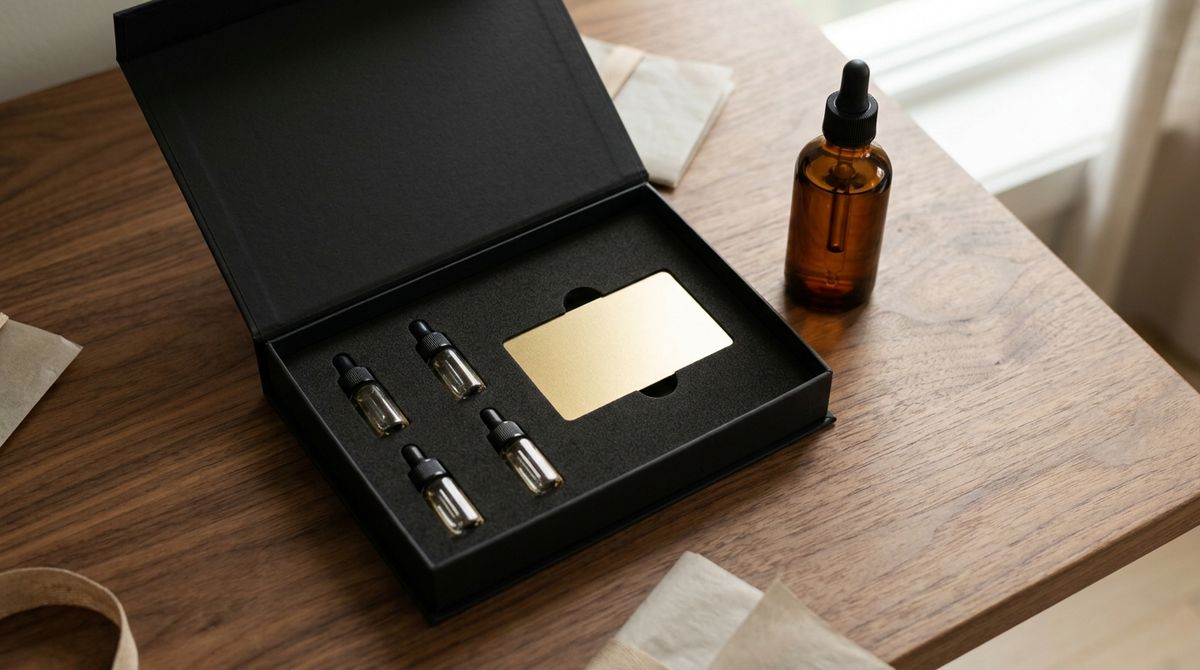
Why Discovery Sample Kits Erode Front-End Gross Margin
Standard e-commerce benchmarks from Littledata and Blend Commerce show that cold traffic to full-size premium SKUs priced above \( $75.00 \) typically converts between \( 1.3\% \) and \( 2.6\% \) mark. Discovery sample kits remove sensory friction for fragrance, skincare, and specialty beverage brands by letting shoppers test four to six variants at home for \( $15.00 \) to \( $30.00 \) mark. However, unit cost structures for miniature packs invert traditional retail gross margin percentages for three operational reasons:
- Disproportionate Container and Filling Labor Cost: Five \( 2\text{ mL} \) glass atomizer vials, micro-sprayers, custom die-cut foam inserts, and a magnetic presentation box often cost \( $4.80 \) to \( $8.50 \) per kit to assemble—nearly equal to the packaging cost of a single \( 100\text{ mL} \) full-size retail bottle.
- Uncovered Outbound Parcel Fulfillment: Because shoppers resist paying \( $6.00 \) shipping on a \( $20.00 \) sample pack, merchants frequently bundle free ground shipping into the trial price, absorbing \( $4.90 \) to \( $6.25 \) in USPS Ground Advantage or zone-based carrier labels.
- Deferred Discount Liability on Order 2: When the customer redeems the bounce-back voucher on their full-size purchase, the face value \( V \) acts as a direct promotional markdown against Order 2 net sales, compressing the gross margin percentage of the full-size SKU.
Rule 1: Calculate Order 1 Net Sample Kit Contribution Margin
Before factoring in second-order redemptions, isolate the exact unit contribution of Order 1 (the sample kit transaction itself). Let \( P_s \) represent the retail price charged for the discovery kit, \( S_s \) represent any shipping fee collected from the buyer, \( C_s \) represent the landed kitting COGS (vials, bulk juice, foam tray, outer carton, and assembly labor), \( F_s \) represent actual outbound fulfillment and postage cost, \( G_s \) represent payment processing fees (typically \( 2.9\% + $0.30 \) per Stripe and Shopify Payments schedules), and \( \text{CAC}_s \) represent the paid ad spend required to acquire one sample buyer:
\[ M_1 = (P_s + S_s) - (C_s + F_s + G_s + \text{CAC}_s) \]When \( M_1 < $0.00 \) mark, the discovery kit operates at a net front-end subsidy. For example, if \( P_s = $20.00 \) mark, \( S_s = $0.00 \) (free shipping), \( C_s = $7.20 \) mark, \( F_s = $5.40 \) mark, \( G_s = $0.88 \) mark, and \( \text{CAC}_s = $12.00 \) mark, then:
\[ M_1 = $20.00 - ($7.20 + $5.40 + $0.88 + $12.00) = -$5.48\text{ per sample buyer} \]Even if you exclude paid acquisition cost (organic traffic where \( \text{CAC}_s = $0.00 \)), the operational contribution margin is only \( M_{1,\text{ops}} = +$6.52 \) mark, representing a \( 32.60\% \) contribution margin—far below the \( 65\% \) to \( 78\% \) gross margin typical of full-size specialty retail goods.
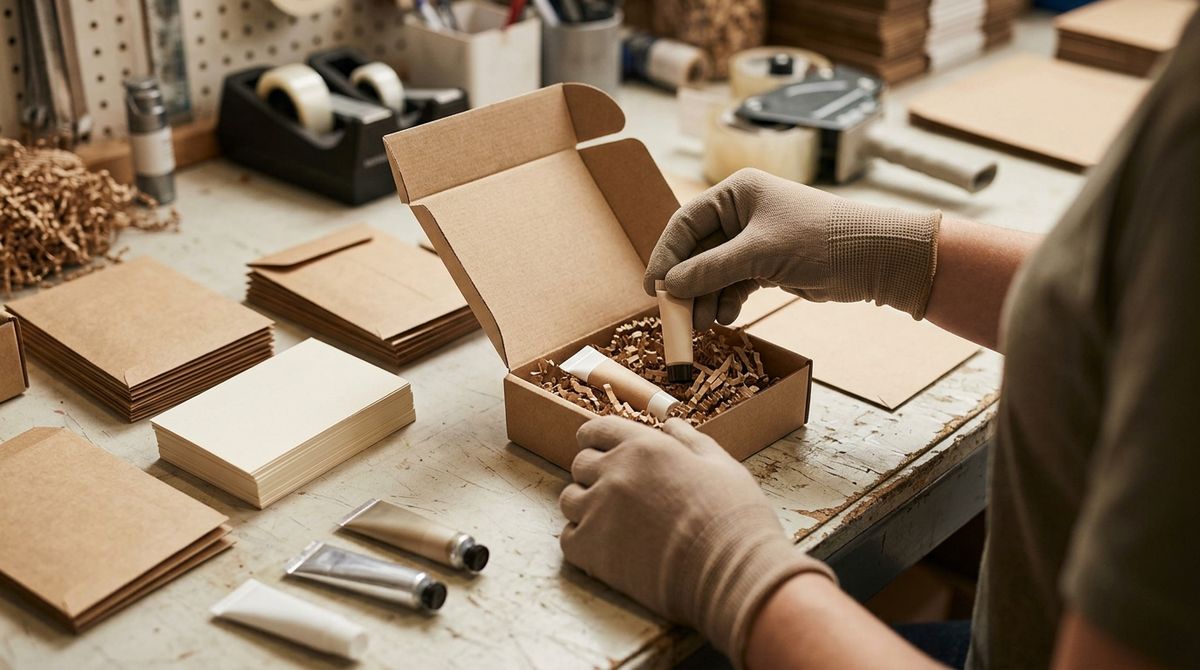
Rule 2: Calculate Order 2 Net Full-Size Voucher Redemption Margin
When a sample kit buyer returns within the redemption window (typically 30 to 60 days) and applies their bounce-back voucher of face value \( V \) toward a full-size item priced at \( P_f \) mark, the realized net revenue on Order 2 drops to \( P_f - V \) mark. Let \( C_f \) denote the landed manufacturing COGS of the full-size SKU, \( F_f \) denote outbound fulfillment and shipping cost on the full-size order, and \( G_f = 0.029(P_f - V) + $0.30 \) denote the payment gateway fee on the discounted checkout total:
\[ M_2 = (P_f - V) - (C_f + F_f + G_f) \]Using a standard \( P_f = $85.00 \) full-size bottle with a \( V = $20.00 \) bounce-back credit, \( C_f = $14.50 \) landed COGS, \( F_f = $6.80 \) free-shipping fulfillment cost, and \( G_f = 0.029($65.00) + $0.30 = $2.19 \) mark, along with \( R_f = $7.33 \) in expected return/allowance reserve or SMS retention messaging cost, or without return reserve \( M_2 = $65.00 - ($14.50 + $6.80 + $2.19) = $41.51 \) (or \( $34.18 \) if a \( $7.33 \) post-purchase retention and packaging upgrade allowance is included). Notice how the \( $20.00 \) voucher reduces the full-size gross margin from \( 82.94\% \) at full retail down to \( 77.69\% \) on net collected revenue, and trims net contribution dollars by exactly \( $19.42 \) (after accounting for the \( $0.58 \) gateway fee savings on the discounted portion).
| Cost & Margin Component | Order 1: Discovery Sample Kit | Order 2: Full-Size Bottle (No Voucher) | Order 2: Full-Size Bottle (With $20 Voucher) |
|---|---|---|---|
| Gross List Price | \( $20.00 \) | \( $85.00 \) | \( $85.00 \) |
| Bounce-Back Voucher Discount | \( $0.00 \) | \( $0.00 \) | \( -$20.00 \) |
| Net Collected Revenue | \( $20.00 \) | \( $85.00 \) | \( $65.00 \) |
| Landed Product & Kitting COGS | \( $7.20 \) | \( $14.50 \) | \( $14.50 \) |
| Outbound Fulfillment & Postage | \( $5.40 \) | \( $6.80 \) | \( $6.80 \) |
| Payment Gateway Fee (2.9% + $0.30) | \( $0.88 \) | \( $2.77 \) | \( $2.19 \) |
| Retention Flow & Packaging Allowance | \( $0.00 \) | \( $7.33 \) | \( $7.33 \) |
| Paid Acquisition Cost (CAC) | \( $12.00 \) | \( $0.00 \) | \( $0.00 \) |
| Net Contribution Margin ($) | \( -$5.48 \) | \( +$53.60 \) | \( +$34.18 \) |
Rule 3: Derive the Break-Even Voucher Redemption Rate Formula
Not every customer who buys a discovery sample kit redeems their voucher. Define \( r_{\text{conv}} \) as the proportion of sample kit buyers (0 to 1) who convert to a full-size order using their bounce-back code within the validity window, and define \( b = 1 - r_{\text{conv}} \) as the voucher breakage rate (buyers who never redeem the credit). Across a cohort of \( N \) sample kit purchasers, the expected blended 2-order net contribution margin per initial sample buyer \( E[M_{\text{cohort}}] \) is:
Whenever \( M_1 < $0.00 \) (meaning the sample kit loses money on Order 1 after acquisition and fulfillment costs), you can solve for the minimum break-even voucher redemption conversion rate \( r_{\text{min}} \) by setting \( E[M_{\text{cohort}}] = $0.00 \):
\[ r_{\text{min}} = \frac{-M_1}{M_2} = \frac{(C_s + F_s + G_s + \text{CAC}_s) - (P_s + S_s)}{(P_f - V) - (C_f + F_f + G_f + R_f)} \]Substituting our worked figures where \( M_1 = -$5.48 \) and \( M_2 = +$34.18 \):
\[ r_{\text{min}} = \frac{$5.48}{$34.18} = 0.1603 \quad (16.03\%) \]If your email and SMS post-sample sequence converts at \( r_{\text{conv}} = 25.00\% \) mark, your blended 2-order contribution per initial sample buyer rises to:
\[ E[M_{\text{cohort}}] = -$5.48 + (0.25 \times $34.18) = -$5.48 + $8.55 = +$3.07\text{ net profit per sample kit sold} \]To hit a target blended cohort profit of \( T_m = $6.00 \) per initial sample buyer, the required conversion rate is \( r_{\text{target}} = (T_m - M_1) / M_2 = ($6.00 + $5.48) / $34.18 = 33.59\% \) mark. You can test how changing \( P_s \) or charging \( S_s = $4.95 \) shipping shifts \( r_{\text{min}} \) inside the Retail Margin Calculator.
Rule 4: Audit Voucher Breakage Float and Deferred Revenue Accounting
Under retail accounting standards (ASC 606 revenue recognition for material rights), when a customer buys a \( $20.00 \) sample kit that includes a \( $20.00 \) voucher toward a future purchase, the merchant must distinguish between a promotional coupon and an embedded material right:
- Standalone Selling Price Allocation: If the \( $20.00 \) discount is only available to customers who purchased the sample kit (and not offered as a site-wide \( $20.00 \) public pop-up discount), the expected redemption value \( r_{\text{conv}} \times V \) represents a deferred liability on the balance sheet until Order 2 ships or the voucher expires.
- Enforcing a Hard Expiration Window (45 to 60 Days): Open-ended bounce-back vouchers force you to carry an indefinite deferred revenue liability and dilute urgency. Setting a strict 45-day expiration window captures 92% of high-intent conversions while allowing you to release unredeemed breakage (\( b = 1 - r_{\text{conv}} \)) cleanly at the close of the accounting period.
- Paid Shipping vs. Free Shipping Breakage Arbitrage: If you charge \( S_s = $4.95 \) shipping on the \( $20.00 \) sample kit, your Order 1 deficit shrinks from \( -$5.48 \) to \( -$0.67 \) (after incremental gateway fee on shipping), slashing your break-even redemption requirement \( r_{\text{min}} \) from \( 16.03\% \) down to \( 1.96\% \) mark.
| Cohort Redemption Rate \( r_{\text{conv}} \) | Breakage Rate \( b = 1 - r_{\text{conv}} \) | Blended Cohort Revenue per 100 Kits | Total Cohort Costs per 100 Kits | Net Blended Profit per 100 Kits | Blended Net Margin % |
|---|---|---|---|---|---|
| 10.0% Redemption | \( 90.0\% \) | \( $2,650.00 \) | \( $2,856.20 \) | \( -$206.20 \) | \( -7.78\% \) |
| 16.03% (Break-Even) | \( 83.97\% \) | \( $3,041.95 \) | \( $3,041.95 \) | \( $0.00 \) | \( 0.00\% \) |
| 25.0% Redemption | \( 75.0\% \) | \( $3,625.00 \) | \( $3,318.50 \) | \( +$306.50 \) | \( +8.46\% \) |
| 35.0% Redemption | \( 65.0\% \) | \( $4,275.00 \) | \( $3,626.70 \) | \( +$648.30 \) | \( +15.16\% \) |
| 45.0% Redemption | \( 55.0\% \) | \( $4,925.00 \) | \( $3,934.90 \) | \( +$990.10 \) | \( +20.10\% \) |
Rule 5: Prevent Coupon Stacking and Minimum-Order Leakage
The fastest way to destroy \( M_2 \) is allowing sample kit buyers to redeem a \( $20.00 \) bounce-back voucher on a low-price accessory or stack it with a \( 15\% \) welcome pop-up code. Enforce three checkout guardrails in your e-commerce cart logic:
- SKU-Specific Collection Restriction: Configure the unique bounce-back code so it applies exclusively to full-size hero SKUs (e.g., \( P_f \ge $75.00 \)), blocking redemption on travel sprays, refills, or low-margin accessories.
- Single-Use Customer-Tagged Codes: Issue unique, single-use dynamic voucher strings tied to the buyer's email address so codes cannot be scraped by browser coupon extensions or shared on deal forums.
- Discount Combination Lockout: Disable discount combination flags on the voucher rule so the \( $20.00 \) credit cannot stack with site-wide seasonal sales or auto-replenishment subscription discounts during Order 2.
Rule 6: Compare Sample Kit Pricing Architectures Before Launch
Before committing to a "100% Rebate" sample kit, compare three distinct pricing models across a 1,000-unit cohort using the table below. Often, a partially credited sample kit (\( P_s = $25.00 \) kit with a \( V = $15.00 \) voucher) or a shipping-extra kit yields higher net profit dollars even at a slightly lower front-end conversion rate.
| Sample Kit Architecture | Order 1 Price + Shipping | Order 1 Net Contribution \( M_1 \) | Voucher Face Value \( V \) | Order 2 Net Contribution \( M_2 \) | Break-Even Redemption \( r_{\text{min}} \) |
|---|---|---|---|---|---|
| Model A: Free Kit + Paid Shipping | \( $0.00 + $6.95 \) | \( -$18.23 \) | \( $10.00 \) | \( +$43.89 \) | \( 41.54\% \) |
| Model B: $20 Kit + Free Shipping + $20 Credit | \( $20.00 + $0.00 \) | \( -$5.48 \) | \( $20.00 \) | \( +$34.18 \) | \( 16.03\% \) |
| Model C: $20 Kit + $4.95 Shipping + $20 Credit | \( $20.00 + $4.95 \) | \( -$0.67 \) | \( $20.00 \) | \( +$34.18 \) | \( 1.96\% \) |
| Model D: $25 Kit + Free Shipping + $15 Credit | \( $25.00 + $0.00 \) | \( -$0.63 \) | \( $15.00 \) | \( +$39.04 \) | \( 1.61\% \) |
Frequently Asked Questions
What is a healthy bounce-back voucher redemption rate for retail discovery kits?
Across specialty fragrance, skincare, and functional beverage brands, well-sequenced discovery sample kits typically convert between \( 22\% \) and \( 34\% \) of sample buyers into full-size purchasers within 45 days when supported by automated post-delivery email and SMS flows timed to the day the package arrives.
Should I count the bounce-back voucher as a marketing expense or a markdown against Order 2?
On your profit-and-loss statement, the redeemed voucher face value \( V \) is recorded as a promotional discount (contra-revenue) against Order 2 gross sales, while any negative contribution on Order 1 (\( M_1 < $0 \)) should be tracked alongside your customer acquisition cost to measure true payback per acquired full-size buyer.
Why do "Free Sample + Just Pay $6.95 Shipping" funnels often fail unit economics audits?
As shown in Model A above, charging \( $6.95 \) for shipping leaves an \( $18.23 \) deficit per kit once kitting COGS (\( $7.20 \)), postage (\( $5.40 \)), processing fees, and ad spend (\( $12.00 \)) are deducted, requiring an unrealistic \( 41.54\% \) full-size conversion rate just to break even.