Retail Free Shipping Threshold and Freight Absorption Margin Formula: 5 Essential AOV Lift Calculations
Setting a store-wide shipping promo without calculating the free shipping threshold margin formula is the single most common reason growing Shopify and omnichannel brands complain that "AOV is up, but net margins are trash." Across r/shopify and r/ecommerce, merchants routinely copy a competitor's arbitrary "$50 Free Shipping" banner or follow generic blog advice to "set your threshold 15% above AOV"—only to discover that absorbing a $9.80 outbound carrier label plus a $1.70 multi-item box upgrade completely wipes out the gross profit earned on the extra item the customer added to their cart! Before changing your checkout banner, model your exact SKU gross margins in the Retail Margin Calculator and apply the freight-absorption math below.
- Why "AOV + 15%" Fails Low-Margin Stores: On a $60 baseline AOV with a 35% gross margin, lifting the cart by 15% (+$9.00) only generates $3.15 in gross profit—which cannot cover an $8.90 absorbed shipping label, resulting in a -$5.75 net profit loss per order.
- The Master Free Shipping Threshold (\(\text{FST}_{\min}\)) Formula: \(\text{FST}_{\min} = \text{AOV}_{\text{base}} + \frac{S_{\text{outbound}} + \Delta C_{\text{pack}}}{m_{\text{gross}} - f_{\text{pay}}}\).
- The Dimensional Weight (DIM 139) Trap: Adding a bulky low-margin item to cross the free-shipping line can push parcel volume (\(L \times W \times H / 139\)) into the next carrier weight bracket, spiking freight cost by $4 to $9.
- The Modal (Median) Cart Rule: Anchor \(\text{AOV}_{\text{base}}\) to your median or modal single-item cart value—never a skewed mean AOV inflated by wholesale or VIP orders.
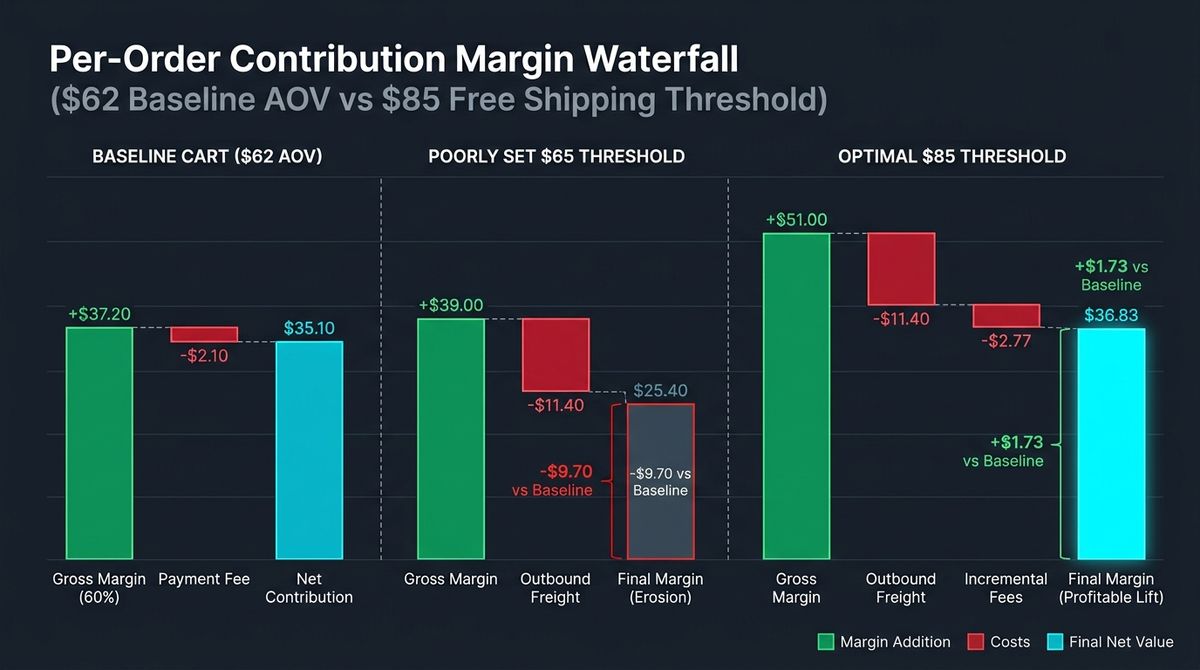
1. Why the Generic "AOV + 15%" Rule Destroys Net Contribution Margin
Almost every generic e-commerce marketing blog repeats the same rule of thumb: "Take your current Average Order Value ($60) and add 15% to 20% ($70) to set your Free Shipping Threshold." Let us test that advice with elementary accounting. When a customer with a $60.00 baseline cart pays $7.95 for flat-rate shipping on a store with a 40% product gross margin (\(m_{\text{gross}} = 0.40\)), a 3.2% effective payment processing fee (\(f_{\text{pay}} = 0.032\)), and an actual carrier + packaging cost of $8.50 (\(S_{\text{outbound}} = \$8.50\)), your baseline net contribution margin is:
$$\text{CM}_{\text{paid-ship}} = \$60.00 \times (0.40 - 0.032) + \$7.95_{\text{ship-rev}} - (\$7.95 \times 0.032) - \$8.50_{\text{carrier}} = \$22.08 + \$7.70 - \$8.50 = \mathbf{\$21.28}$$
Now suppose you set a "Free Shipping Over $70" threshold (AOV + 16.7%). The customer adds a $12.00 accessory to bring their cart to $72.00 and unlocks free shipping (paying $0.00 shipping revenue, while the extra item increases your box and carrier weight cost by \(\Delta C_{\text{pack}} = \$1.10\) to $9.60 total). Your new contribution margin is:
$$\text{CM}_{\text{free-ship,\$72}} = \$72.00 \times (0.40 - 0.032) - \$9.60_{\text{carrier}} = \$26.50 - \$9.60 = \mathbf{\$16.90 \quad (-\text{\$4.38 Profit Loss!})}$$
Even though your Shopify dashboard celebrates a +20% jump in Average Order Value ($60 to $72), you actually lost $4.38 in real bottom-line profit (a 20.6% profit drop) on that order because the $4.42 of net product margin on the $12 add-on item was Less than the $8.80 of lost shipping revenue and extra box weight!
2. Formula 1: The Break-Even & Target Free Shipping Threshold (\(\text{FST}\)) Equation
To ensure that every customer who stretches their cart from your baseline modal order value (\(\text{MOV}_{\text{base}}\)) up to your Free Shipping Threshold (\(\text{FST}\)) generates at least as many net contribution dollars as a paid-shipping order (plus a target profit buffer \(\Delta P_{\text{target}}\)), apply the Master Free Shipping Threshold Formula:
$$\text{FST}_{\text{optimal}} = \text{MOV}_{\text{base}} + \frac{S_{\text{charged}} \cdot \left(1 - f_{\text{pay}}\right) + \Delta S_{\text{carrier}} + \Delta C_{\text{pack}} + \Delta P_{\text{target}}}{m_{\text{gross}} - f_{\text{pay}}}$$
- \(\text{MOV}_{\text{base}}\) (Modal / Median Single-Order Value): The most frequent cart subtotal before shipping. (If your flagship SKU is $48, use $48—not a $64 mean AOV skewed by occasional $300 orders.)
- \(S_{\text{charged}} \cdot (1 - f_{\text{pay}})\): The net shipping fee revenue you forfeit when the order crosses the free-shipping line (or use your full absorbed outbound freight cost \(S_{\text{outbound}}\) if comparing against a zero-subsidy baseline).
- \(\Delta S_{\text{carrier}} + \Delta C_{\text{pack}}\): The incremental carrier weight/zone jump and larger corrugated box cost caused by adding the 2nd or 3rd item to the parcel.
- \(m_{\text{gross}} - f_{\text{pay}}\) (Net Variable Product Margin Ratio): Product gross margin percentage minus your payment gateway percentage rate.
Using our $60.00 baseline example above (\(m_{\text{gross}} = 0.40\), \(f_{\text{pay}} = 0.032\), \(S_{\text{charged}}(1 - f_{\text{pay}}) = \$7.70\), \(\Delta S_{\text{carrier}} + \Delta C_{\text{pack}} = \$1.10\), and \(\Delta P_{\text{target}} = \$1.50\) profit lift):
$$\text{FST}_{\text{optimal}} = \$60.00 + \frac{\$7.70 + \$1.10 + \$1.50}{0.40 - 0.032} = \$60.00 + \frac{\$10.30}{0.368} = \$60.00 + \$27.99 = \mathbf{\$87.99 \to \$89.00\text{ Threshold}}$$
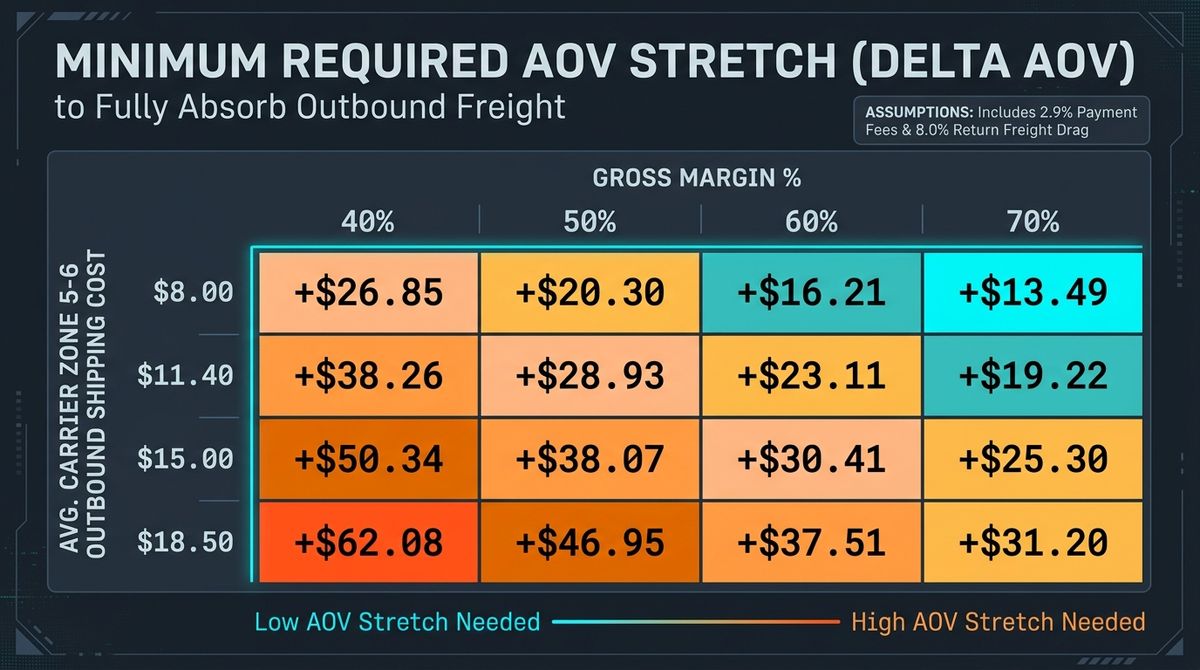
3. Complete Gross Margin vs Free Shipping Threshold Sizing Table
Reference the verified financial matrix below to see how your product gross margin (\(m_{\text{gross}}\)) dictates the minimum profitable Free Shipping Threshold for a store with a $55.00 modal baseline cart and $8.50 absorbed shipping + box delta (\(f_{\text{pay}} = 3.0\%\)):
| Store Gross Margin Tier (\(m_{\text{gross}}\)) | Net Margin Ratio (\(m_{\text{gross}} - f_{\text{pay}}\)) | Req. Cart Dollar Lift (\(\Delta \text{Cart}_{\min}\)) | Break-Even Threshold (\(\text{FST}_{\min}\)) | Profit-Accretive Threshold (+\$2.50 Lift) | Recommended Strategy |
|---|---|---|---|---|---|
| 20% Gross Margin (Electronics / Reseller) | 17.0% | +$50.00 (+90.9%) | $105.00 | $119.71 ($120) | Do not offer low-threshold free shipping; charge flat/actual freight |
| 35% Gross Margin (Hardgoods / Gear) | 32.0% | +$26.56 (+48.3%) | $81.56 | $89.38 ($89) | Set threshold at $89; pair with 2-unit bundle upsell |
| 50% Gross Margin (Apparel /DTC) | 47.0% | +$18.09 (+32.9%) | $73.09 | $78.40 ($79) | Set threshold at $75–$79; add $25 high-margin checkout add-on |
| 65% Gross Margin (Footwear / Specialty) | 62.0% | +$13.71 (+24.9%) | $68.71 | $72.74 ($75) | Set threshold at $70–$75; high conversion + strong profit lift |
| 80% Gross Margin (Supplements / Cosmetics) | 77.0% | +$11.04 (+20.1%) | $66.04 | $69.29 ($69) | Set threshold at $65–$69; low COGS absorbs freight easily |
This table explains why merchants in r/shopify_growth get crushed when copying a supplement brand's "$65 Free Shipping" threshold onto a 35% gross margin hardgoods catalog: a 35% margin store needs at least an $82 to $89 threshold to cover the exact same $8.50 shipping label.
4. Formula 2: The Dimensional Weight (DIM 139) Step-Function Penalty
In physical retail and e-commerce fulfillment, shipping cost is not a smooth linear function of price—it is a step function of Billable Weight (\(W_{\text{billable}}\)) across USPS Ground Advantage, UPS, and FedEx zones:
$$W_{\text{billable}} = \max\left(W_{\text{scale,lbs}}, \; \left\lceil\frac{L_{\text{in}} \times W_{\text{in}} \times H_{\text{in}}}{D_{\text{DIM}}}\right\rceil\right) \quad \text{where } D_{\text{DIM}} = 139\text{ (UPS/FedEx) or } 166\text{ (USPS } > 1\text{ ft}^3\text{)}$$
Suppose your core product ships in an \(8^{\prime\prime} \times 6^{\prime\prime} \times 4^{\prime\prime}\) box weighing \(14\text{ oz}\) (Under-1-lb USPS Ground Advantage rate \(\approx \$5.15\)). If a customer adds a bulky $15 water bottle or foam roller to cross your Free Shipping Threshold, two things happen at the pack station:
- Scale weight crosses the 15.999 oz (1.0 lb) threshold into the 2 lb Zone 6 Priority/Ground tier (jumping from $5.15 to $8.90).
- Or the packer must step up to a \(14^{\prime\prime} \times 10^{\prime\prime} \times 8^{\prime\prime}\) carton (\(1,120\text{ in}^3 / 139 = \mathbf{9\text{ lbs DIM weight}}\)), spiking the carrier bill to $14.80!
The In-Cart Upsell Rule: Only display in-cart "Add $X for Free Shipping" carousel items that have (a) a gross margin \(\ge 65\%\) and (b) near-zero marginal weight and volume (\(\le 3\text{ oz}\)) so they fit inside the existing primary mailer without changing box dimensions.
5. Eliminating Shipping & Discount Leakage Across Online and POS Channels
To lock in your freight margins across both your e-commerce store and physical retail registers, implement these four operational controls:
- Calculate FST on Post-Discount Cart Subtotal: Configure your cart rules so free shipping is evaluated after promo codes are deducted. Never give free shipping on a $80 cart that was discounted to $60 with a 25% coupon.
- Exclude Heavy/Oversized SKUs via Shipping Profiles: Assign heavy or bulky items (`> 5 lbs` or `> 800 cubic inches`) to a dedicated bulky-freight profile with a separate shipping surcharge.
- Use a Free High-Margin Gift Threshold When Freight Is High: As noted by apparel founders on r/ecommerce, offering a "Free Mystery Accessory at $120" that costs you $2.80 in COGS and weighs 2 oz is often 3x more profitable than absorbing $11.50 in free shipping.
- Enforce In-Store POS Override Controls: Prevent floor associates from manually waiving ship-to-home freight fees or stacking unapproved register discounts at the physical terminal.
Frequently Asked Questions
Should I bake shipping costs into my product prices and offer "Free Shipping on Everything"?
As discussed in r/shopify pricing tests, baking $8 of shipping into a single $25 item forces you to price it at $33—which kills your conversion rate on Google Shopping and Meta ads while penalizing customers who buy 3 units (who pay that baked-in $8 shipping fee three times). Setting a strategic Free Shipping Threshold at 2x your flagship unit price keeps single-unit prices competitive while rewarding multi-unit carts.
Why should I use Modal or Median Order Value instead of Average Order Value (AOV)?
If 80% of your customers buy a single $45 item and 20% buy a $170 bundle, your mathematical mean AOV is $70—but almost no customer actually has a $70 cart! Setting your threshold at $85 (1.9x the $45 modal cart) forces the 80% majority to add a second $45 unit ($90 cart), whereas setting it at $55 ("just above $45") leaves money on the table.
How do I handle Alaska, Hawaii, and international orders on a Free Shipping banner?
Restrict your standard Free Shipping Threshold strictly to contiguous domestic ground shipping (Lower 48 U.S. states) in your shipping zone settings, and offer a discounted flat-rate subsidy for air-zone destinations.
Conclusion: Calculate Your Store's Exact Free Shipping Threshold
Stop letting arbitrary shipping banners eat your hard-earned gross profit. Plug your baseline cart value, carrier label cost, and product gross margin into the Retail Margin Calculator right now to lock in a mathematically profitable Free Shipping Threshold. And if you also run brick-and-mortar registers where staff discount overrides and manual ship-to-home waivers erode daily store margins, equip your team with Till Trainer to standardize POS margin discipline across every shift.