Retail Gift Card Breakage, Deferred Revenue Liability, and Redemption Upsell Lift Margin Formula: 6 POS Audit Calculations
Executive Retail Audit Summary: Selling \( \$50{,}000\text{ USD} \) in holiday gift cards injects immediate working capital into your bank account, but under GAAP (ASC 606-10-55-46) and state unclaimed property (escheatment) statutes, \( 100\% \) of that cash inflow must initially be booked as a Deferred Gift Card Revenue Liability on your balance sheet. Where gift cards transform into a margin multiplier is the combination of proportional breakage recognition (\( 6\% \) to \( 18\% \) unredeemed balances in non-escheat states) and redemption overspend lift (customers spending an average of \( +38\% \) above face value at full retail gross margin). Run the 6 POS audit calculations below and model your store's exact gross margin lift inside the Retail Margin Calculator.
1. Calculation 1: Deferred Revenue Liability & Working Capital Float Formula
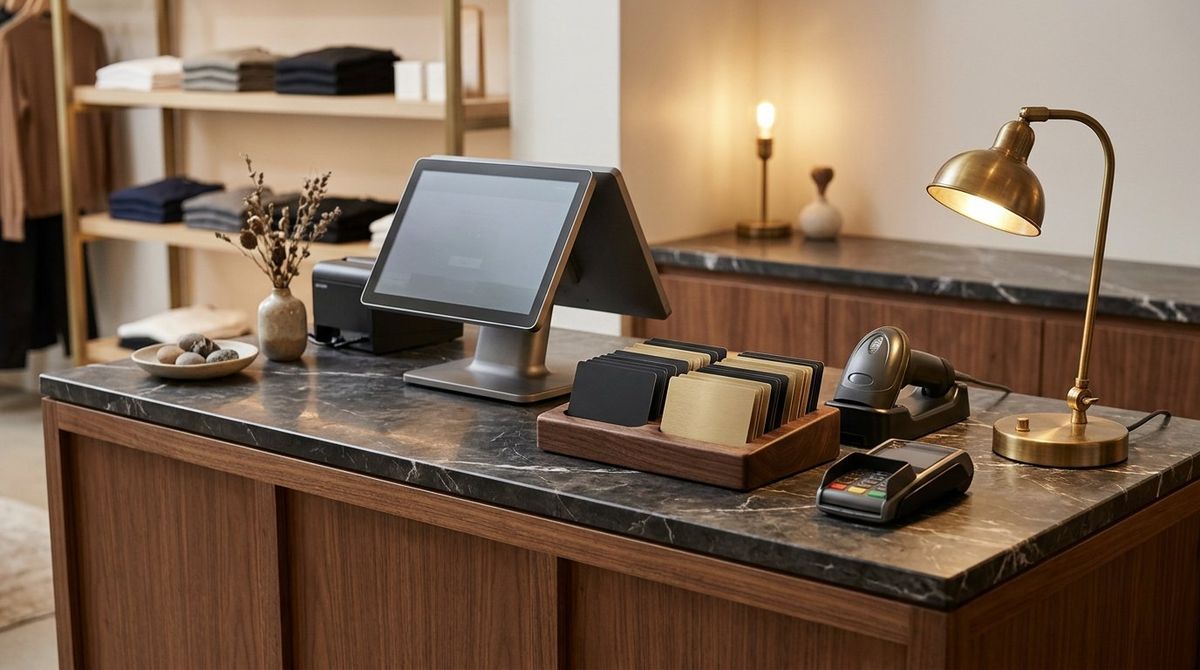
When a customer purchases a \( \$100.00\text{ USD} \) gift card via credit card on Square POS or Shopify POS, the merchant pays the payment processor interchange fee \( C_{\text{proc}} \) plus physical PVC card printing cost \( C_{\text{plastic}} \) immediately, while recording the full \( \$100.00\text{ USD} \) face value as a current liability \( L_{\text{deferred}}(t) \). Across a cohort issuance volume \( V_{\text{issued}} \), cumulative redemptions \( R_{\text{cum}}(t) \), and recognized breakage \( B_{\text{cum}}(t) \), your outstanding balance-sheet gift card liability at month \( t \) is:
\[ L_{\text{deferred}}(t) = V_{\text{issued}} - R_{\text{cum}}(t) - B_{\text{cum}}(t) \text{ USD} \]Meanwhile, your net day-one cash float \( \text{Float}_{\text{net},0} \) available to fund high-turn inventory before a single unit of COGS leaves the shelf is:
\[ \text{Float}_{\text{net},0} = V_{\text{issued}} \cdot \left( 1 - r_{\text{proc}} \right) - N_{\text{cards}} \cdot \left( C_{\text{plastic}} + \$0.30\text{ USD} \right) \text{ USD} \]| Retail Vertical | Historical Breakage Rate (\( b_{\text{est}} \)) | Mean Overspend Lift (\( \lambda_{\text{upsell}} \)) | 12-Month Redemption Velocity |
|---|---|---|---|
| Specialty Coffee & QSR | \( 14.0\% - 22.0\% \) (Micro-balances) | \( +24.0\% \) Above Face Value | \( 74\% \) Redeemed in Year 1 |
| Apparel & Footwear Boutiques | \( 8.0\% - 12.0\% \) | \( +42.0\% \) Above Face Value | \( 81\% \) Redeemed in Year 1 |
| Salons, Spas & Personal Care | \( 15.0\% - 28.0\% \) | \( +35.0\% \) (Service Add-Ons) | \( 62\% \) Redeemed in Year 1 |
| Hardgoods & Sporting Goods | \( 6.0\% - 9.5\% \) | \( +48.0\% \) (High-Ticket Step-Up) | \( 85\% \) Redeemed in Year 1 |
2. Calculation 2: ASC 606 Proportional Breakage Recognition Formula
As highlighted in r/smallbusiness gift card accounting threads and Square gift card redemption discussions, you cannot legally book unredeemed gift cards as revenue on the day of sale, nor do you have to wait \( 10\text{ years} \) in non-escheat jurisdictions. Under ASC 606 (Proportional Method), if your store has historical POS data proving an expected breakage rate \( b_{\text{est}} \) (for example, \( b_{\text{est}} = 0.12 \), meaning \( 12\% \) of card value is never redeemed and \( 88\% \) is expected to be redeemed), you recognize breakage revenue \( B_t \) in direct proportion to actual customer redemptions \( R_t \) during period \( t \):
\[ B_t = V_{\text{issued}} \cdot b_{\text{est}} \cdot \left( \frac{R_t}{V_{\text{issued}} \cdot \left( 1 - b_{\text{est}} \right)} \right) = R_t \cdot \left( \frac{b_{\text{est}}}{1 - b_{\text{est}}} \right) \text{ USD} \]For a \( \$50{,}000\text{ USD} \) holiday gift card cohort with an estimated \( 12.0\% \) breakage rate (\( \$6{,}000\text{ USD} \) expected breakage and \( \$44{,}000\text{ USD} \) expected redemptions), if customers redeem \( R_1 = \$22{,}000\text{ USD} \) in January (exactly \( 50\% \) of expected total redemptions), your accountant recognizes \( B_1 = \$3{,}000\text{ USD} \) in pure \( 100\%\text{-margin} \) breakage revenue in January—reducing the deferred liability from \( \$50{,}000\text{ USD} \) down to \( \$25{,}000\text{ USD} \).
3. Calculation 3: State Escheatment (Unclaimed Property) Haircut Formula
As retail owners warn in r/smallbusiness state gift card escheatment threads and business succession liability discussions, federal law (the CARD Act of 2009) prohibits gift cards from expiring within \( 5\text{ years} \), and approximately \( 27 \) U.S. states enforce unclaimed property (escheat) statutes requiring merchants to remit \( \gamma_{\text{escheat}} = 60\% \) to \( 100\% \) of dormant gift card balances to the state treasury after a \( 3\text{-year} \) to \( 5\text{-year} \) dormancy period. Therefore, your net retainable breakage \( B_{\text{net}} \) is:
\[ B_{\text{net}} = V_{\text{issued}} \cdot b_{\text{est}} \cdot \left( 1 - \gamma_{\text{escheat}} \right) \text{ USD} \]In states that exempt closed-loop retail gift cards without expiration dates or dormancy fees from escheatment (\( \gamma_{\text{escheat}} = 0 \)), the merchant retains \( 100\% \) of \( B_{\text{net}} \). In strict \( 100\% \) escheat states (\( \gamma_{\text{escheat}} = 1.0 \)), you cannot recognize breakage revenue at all—meaning your profit lift must come from redemption overspend.
4. Calculation 4 & 5: Redemption Overspend Lift & Cohort Effective Gross Margin
Psychologically, consumers treat a \( \$50.00\text{ USD} \) gift card as "found money," motivating them to step up to a \( \$69.00\text{ USD} \) or \( \$75.00\text{ USD} \) item and pay the difference out of pocket. Let \( R_{\text{face}} = V_{\text{issued}} \cdot (1 - b_{\text{est}}) \) represent redeemed face value, \( \lambda_{\text{upsell}} \) represent the average overspend percentage on redeemed cards (\( U_{\text{overspend}} = R_{\text{face}} \cdot \lambda_{\text{upsell}} \)), and \( m_{\text{gross}} = \frac{P - \text{COGS}}{P} \) represent your store's standard merchandise gross margin. The Effective Cohort Gross Margin (\( \text{GM}_{\text{cohort}} \)) across the entire gift card program is:
\[ \text{GM}_{\text{cohort}} = \frac{\left( R_{\text{face}} + U_{\text{overspend}} \right) \cdot m_{\text{gross}} + B_{\text{net}} - C_{\text{issuance-fees}}}{R_{\text{face}} + U_{\text{overspend}} + B_{\text{net}}} \times 100\% \]Consider a boutique with a \( 52.0\% \) merchandise gross margin (\( m_{\text{gross}} = 0.52 \)) issuing \( \$50{,}000\text{ USD} \) in gift cards with \( 10.0\% \) retainable breakage (\( B_{\text{net}} = \$5{,}000\text{ USD} \), \( R_{\text{face}} = \$45{,}000\text{ USD} \)), a \( +38.0\% \) redemption overspend lift (\( U_{\text{overspend}} = \$17{,}100\text{ USD} \)), and \( \$1{,}350\text{ USD} \) in card processing/printing fees. Total recognized revenue jumps from \( \$50{,}000\text{ USD} \) to \( \$67{,}100\text{ USD} \), and net gross profit reaches \( \$35{,}942\text{ USD} \)—lifting effective gross margin to \( 53.56\% \) while generating \( \$8{,}892\text{ USD} \) in incremental upsell gross profit that would not have existed without the gift card visit!

5. Calculation 6: Promotional Bonus Card ("Buy $100, Get $20 Free") Break-Even Formula
During Q4 holiday drives, retailers frequently run a "Buy a $100 Gift Card, Get a $20 Bonus Card" promotion. Crucially, the \( \$20\text{ USD} \) promotional bonus card is a marketing discount—not paid deferred revenue—and can legally carry a short \( 30\text{-day} \) or \( 60\text{-day} \) promotional expiration window (e.g., valid January 1 to February 28). To prevent the \( \$20\text{ USD} \) bonus COGS from eroding your baseline dollar gross profit on the \( \$100\text{ USD} \) card, the minimum out-of-pocket overspend \( U_{\min} \) required when the customer redeems the cards is:
\[ U_{\min} = \frac{V_{\text{bonus}} \cdot \left( 1 - m_{\text{gross}} \right)}{m_{\text{gross}}} \text{ USD} \]At a \( 50.0\% \) retail gross margin (\( m_{\text{gross}} = 0.50 \)), a \( \$20.00\text{ USD} \) bonus card carries \( \$10.00\text{ USD} \) in wholesale COGS, requiring just \( U_{\min} = \$10.00 / 0.50 = \$20.00\text{ USD} \) in out-of-pocket overspend across the two visits to break even—and because \( 35\% \) to \( 45\% \) of January promotional bonus cards expire unredeemed, the promotion is strongly margin-accretive.
Audit Your Store's Gift Card Breakage, Upsell Lift & Promotional Margin
Model your exact merchandise gross margin, POS processing fees, and promotional discount break-even volume in seconds.
Launch the Retail Margin Calculator