Retail Paid Gift-Wrap Service Fee, Packing-Bench Labor Seconds & Holiday Basket Contribution Margin Formula: 6 Fulfillment Rules
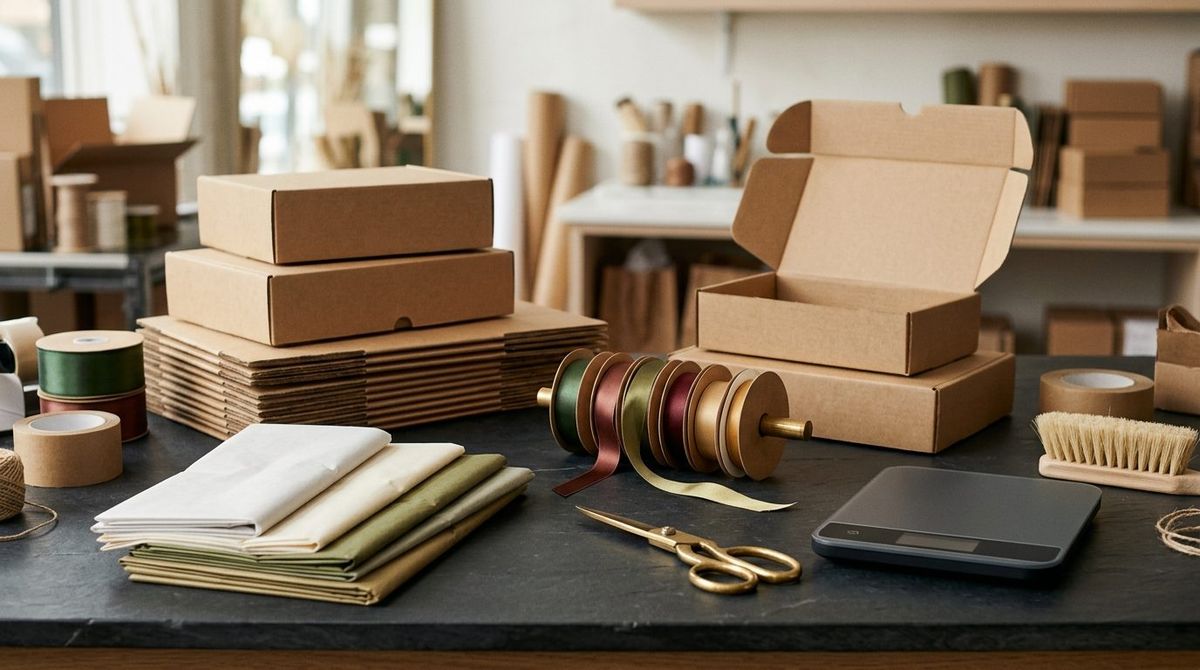
Offering a paid gift-wrap add-on at checkout looks like pure high-margin revenue until peak Q4 order volume hits your packing bench. A flat $3.00 or $4.00 fee routinely loses money once you account for wrapping paper, satin ribbon, a rigid presentation box, 75 to 180 seconds of bench labor, and the dimensional weight (DIM) shipping jump triggered when a wrapped box forces a larger outer mailer. Before setting your checkout add-on price, you need an exact unit-economics equation that isolates every fulfillment cost.
Core Gift-Wrap Contribution Margin Equation:
\[\Pi_{\text{wrap}} = P_{\text{fee}} - C_{\text{mat}} - \frac{t_{\text{wrap,sec}}}{3600} \cdot r_{\text{labor}} - \Delta F_{\text{DIM}}\]
Where \(P_{\text{fee}}\) is the checkout gift-wrap fee, \(C_{\text{mat}}\) is total wrap and presentation box material cost, \(t_{\text{wrap,sec}}\) is incremental bench kitting time in seconds, \(r_{\text{labor}}\) is the fully burdened hourly warehouse wage, and \(\Delta F_{\text{DIM}}\) is any incremental carrier dimensional surcharge caused by upsizing the outer carton.
To benchmark your exact break-even add-on price across your store catalog, plug your material bills and labor rates into the interactive margin tools at retailmargincalculator.com. Below are the six operational fulfillment rules that keep paid gift-wrapping profitable during holiday spikes.
Rule 1: Meter Incremental Packing-Bench Seconds Instead of Guessing
Most merchants underestimate how long gift wrapping actually takes under real warehouse conditions. Wrapping a single rectangular book takes roughly 75 seconds when paper is pre-cut, whereas assembling a rigid gift box, stuffing crinkle fill, tying a double satin bow, and printing a custom gift note takes 150 to 180 seconds. You must measure only the incremental seconds above your baseline standard-order pack time.
At a fully burdened warehouse labor rate of \(r_{\text{labor}} = \$24.00\text{ / hr}\) (including payroll taxes and benefits), each second at the packing bench costs \(\$24.00 / 3600 = \$0.00667\text{ / sec}\). That means a 75-second paper-and-sticker wrap costs \(\$0.50\) in labor, while a 180-second rigid-box-and-ribbon presentation costs \(\$1.20\) in labor before you even touch materials.
Rule 2: Include Both Consumables and Outer-Carton Upsize Surcharges
A common accounting mistake is pricing gift wrap off the wholesale cost of tissue paper and ribbon alone. A realistic material bill \(C_{\text{mat}}\) includes the outer gift box or heavy matte wrap (\(\$0.85\) to \(\$1.65\)), tissue or crinkle fill (\(\$0.20\)), ribbon and gift card stock (\(\$0.35\)), and extra void fill inside the shipping carton (\(\$0.25\)). Total material cost typically lands between \(\$1.25\) and \(\$2.25\) per wrapped unit.
Even more destructive to margin is the DIM-weight step change \(\Delta F_{\text{DIM}}\). If wrapping an item adds 1.5 inches to each dimension, a compact SKU that normally ships in a poly mailer or an \(8 \times 6 \times 4\text{ in}\) box may be forced into a \(10 \times 8 \times 6\text{ in}\) corrugated shipper. Under standard carrier cubic-inch divisors (typically 139 for commercial ground), that jump increases billable DIM weight from 2 lb to 4 lb, adding \(\$1.45\) to \(\$2.85\) in postage unless your shipping matrix recovers it.

Rule 3: Solve the Break-Even Gift-Wrap Price Floor ($4.95 to $7.95)
Setting \(\Pi_{\text{wrap}} = 0\) yields your exact break-even fee floor \(P_{\text{BE}}\):
\[P_{\text{BE}} = C_{\text{mat}} + \frac{t_{\text{wrap,sec}}}{3600} \cdot r_{\text{labor}} + \Delta F_{\text{DIM}}\]
To generate a healthy 35% to 45% contribution margin on the service itself, multiply your break-even floor or add a fixed \(\$1.75\) to \(\$2.50\) target profit buffer. The lookup table below models break-even floors and recommended retail fees across four real-world packing profiles at \(r_{\text{labor}} = \$24.00\text{ / hr}\).
| Fulfillment Profile | Bench Time (\(t_{\text{wrap,sec}}\)) | Labor Cost | Materials (\(C_{\text{mat}}\)) | DIM Jump (\(\Delta F_{\text{DIM}}\)) | Break-Even Floor | Recommended Fee (\(P_{\text{fee}}\)) |
|---|---|---|---|---|---|---|
| Tier 1: Soft Bag + Note | 75 sec | $0.50 | $1.25 | $0.00 | $1.75 | $4.95 |
| Tier 2: Paper Wrap + Bow | 110 sec | $0.73 | $1.60 | $0.95 | $3.28 | $5.95 |
| Tier 3: Rigid Box + Ribbon | 150 sec | $1.00 | $2.10 | $1.85 | $4.95 | $6.95 |
| Tier 4: Oversize Multi-Item Kit | 180 sec | $1.20 | $2.45 | $2.40 | $6.05 | $7.95 |
Rule 4: Pre-Kit Drawstring Pouches and Folding Cartons Before Peak Week
You can cut \(t_{\text{wrap,sec}}\) by 40% to 55% without lowering perceived gift quality by moving away from cut-to-order paper rolls. Pre-sized cotton drawstring bags, magnetic-closure folding boxes, and peel-and-stick satin bows eliminate measuring, cutting, and taping at the bench.
- Standardize Two Box Footprints: Stock only two rigid gift-box sizes matched to your top 80% of SKUs so packers never waste 30 seconds hunting for a fit.
- Pre-Print Gift Cards in Batches: Route gift-note messages to a dedicated thermal or laser card tray beside the label printer rather than handwriting notes.
- Eliminate Loose Paper Rolls: Replace manual roll cutting with pre-scored sheet dispensers or branded gift sleeves that drop wrap time from 150 seconds to 75 seconds.
Rule 5: Model Labor Rate Sensitivity Across Seasonal Overtime
During the final three weeks before Christmas, seasonal overtime and temp-agency markups routinely push effective packing-bench labor from \(\$22.00\text{ / hr}\) to \(\$33.00\text{ / hr}\). If your gift-wrap fee is locked at \(\$4.95\) for a slow 180-second wrap with a DIM upsize, overtime alone wipes out your margin buffer.
| Hourly Labor Rate (\(r_{\text{labor}}\)) | 75-Sec Wrap Labor | 120-Sec Wrap Labor | 180-Sec Wrap Labor | Net Margin at $6.95 Fee (150s, $2.10 Mat, $1.85 DIM) |
|---|---|---|---|---|
| $20.00 / hr (Off-Peak) | $0.42 | $0.67 | $1.00 | +$2.17 (+31.2%) |
| $24.00 / hr (Standard) | $0.50 | $0.80 | $1.20 | +$2.00 (+28.8%) |
| $28.00 / hr (Peak Temp) | $0.58 | $0.93 | $1.40 | +$1.83 (+26.3%) |
| $33.00 / hr (Overtime) | $0.69 | $1.10 | $1.65 | +$1.63 (+23.5%) |
Rule 6: Worked Holiday Basket Example & Upsell Threshold
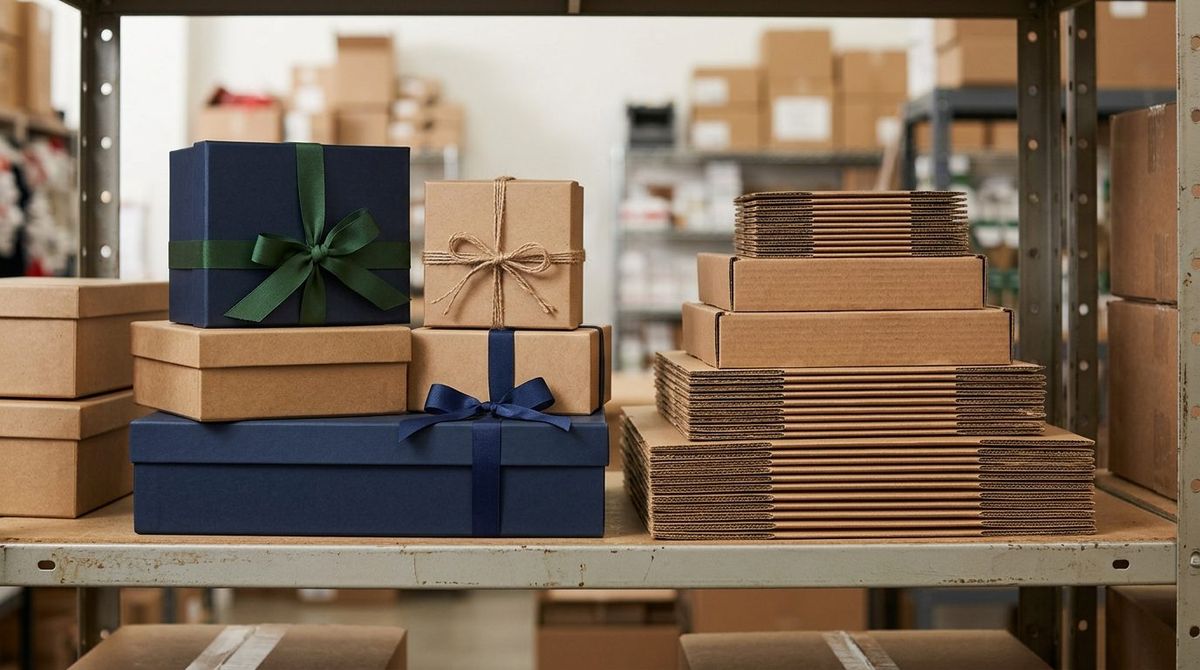
Suppose a customer builds a \(\$68.00\) holiday skincare basket and selects your \(\$6.95\) paid gift-wrap option. Your rigid box, tissue, and ribbon kit costs \(C_{\text{mat}} = \$2.10\), incremental bench assembly takes \(t_{\text{wrap,sec}} = 144\text{ seconds}\) at \(r_{\text{labor}} = \$25.00\text{ / hr}\) (\(\$1.00\) labor), and the larger outer carton triggers a \(\Delta F_{\text{DIM}} = \$1.65\) shipping increase. Your gift-wrap contribution margin is:
\[\Pi_{\text{wrap}} = \$6.95 - \$2.10 - \frac{144}{3600} \cdot \$25.00 - \$1.65 = \$6.95 - \$2.10 - \$1.00 - \$1.65 = +\$2.20\]
That \(+\$2.20\) net contribution adds \(3.2\%\) pure profit lift to the \(\$68.00\) basket without requiring extra ad spend. Conversely, if you had priced the same option at \(\$4.50\), you would lose \(-\$0.25\) on every wrapped order while slowing down your fastest packers during peak week.
Common Gift-Wrap Pricing Mistakes to Avoid
- Offering Per-Order Flat Wrap on Multi-Item Carts: Charging one \(\$5.95\) fee when a shopper buys four separate items that each require individual wrapping multiplies labor and material costs by four while revenue stays flat. Always charge per wrapped unit or limit flat-fee wrapping to one combined gift box.
- Ignoring Payment Processing Fees: A \(2.9\%\) card fee on a \(\$6.95\) upsell deducts \(\$0.20\) immediately; build that into your target buffer above break-even.
- Mixing Gift-Wrap Stations Into Main Pick Lines: Routing custom-wrapped orders through standard conveyor lanes creates bottlenecks. Split gift-wrapped orders into a dedicated batch queue.
Frequently Asked Questions
What is the safest default price for paid retail gift wrapping?
For most e-commerce and specialty retail stores, \(\$5.95\) to \(\$7.95\) per wrapped item covers \(\$1.60\) to \(\$2.45\) in materials, 110 to 180 seconds of packing labor, and typical DIM-box surcharges while leaving a \(+\$1.80\) to \(+\$2.60\) contribution margin.
How do I stop gift wrapping from slowing down Q4 fulfillment?
Batch all gift-wrap orders twice per shift and route them to a separate kitting table stocked with pre-sized drawstring bags or magnetic folding boxes, keeping incremental bench time under 90 seconds.
Should I offer free gift wrapping above a basket threshold?
Only offer free gift wrapping when the minimum cart threshold (such as \(\$100.00\) or \(\$125.00\)) generates enough incremental gross product margin to absorb the \(\$3.25\) to \(\$6.05\) break-even fulfillment cost without eroding net order profit.
How do I calculate if a gift box triggers a DIM shipping surcharge?
Multiply the length, width, and height of the new outer shipper in inches and divide by 139. Compare that rounded-up DIM weight against your standard unwrapped carton rate on your carrier rate card to find exact \(\Delta F_{\text{DIM}}\).