Retail Initial Markup (IMU) Calculation Formula: Comprehensive Pricing and Reduction Guide
Establishing healthy gross margins in retail merchandising requires mastering the retail imu calculation formula to account for operating overhead, planned markdowns, and inventory shrinkage before pricing goods. Many independent store owners and retail buyers mistakenly calculate retail prices by applying a fixed keystone percentage (doubling wholesale cost) or using a basic gross margin target. However, setting prices based purely on desired profit ignores the reality of retail reductions, resulting in severe year-end profit shortfalls.
Initial Markup (IMU)—also referred to as Initial Markon—represents the percentage difference between the wholesale cost of merchandise and its original retail selling price. Because goods rarely sell out at 100% full ticket price without promotional markdowns, seasonal clearance sales, employee discounts, or administrative inventory shrinkage, the initial markup percentage must always be set significantly higher than the final realized Maintained Markup (MMU) target.
Retail IMU Fundamentals
- IMU Must Outpace Maintained Margin: If your business requires a 48% maintained gross margin to clear overhead, your initial markup must frequently exceed 56% to absorb inevitable store reductions.
- The Reduction Triad: Retail reductions consist of three distinct profit drains: customer markdowns (promotional and clearance), inventory shrinkage (theft, damage, vendor discrepancy), and staff discounts.
- Cash Discounts Provide Relief: Earned vendor terms (such as 2/10 net 30) reduce net merchandise cost, providing an offset that lowers the required retail price burden.
- Point-of-Sale Guardrails: Uncontrolled manual cashier overrides quickly dismantle carefully planned IMU targets at checkout, highlighting the need for structured till management.
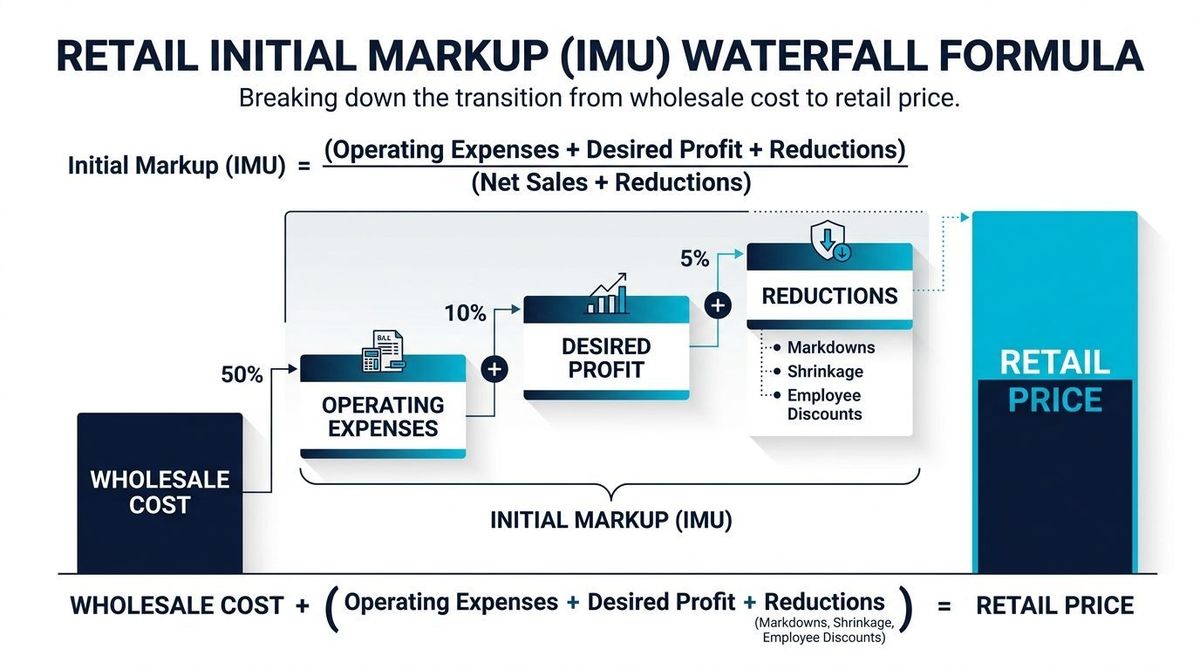
The Classic Merchandising Initial Markup Formula
In retail accounting, all percentage figures are conventionally expressed as a percentage of net sales rather than merchandise cost. To ensure that your initial ticket prices generate sufficient gross margin dollars after reductions, merchandising executives rely on the comprehensive IMU equation:
When operating expenses and net profit targets are combined into the overall Gross Margin Target percentage, the formula simplifies into the standard industry equation:
Where \(\text{Total Reductions \%} = \text{Markdowns \%} + \text{Shrinkage \%} + \text{Employee Discounts \%}\), all calculated as planned percentages of anticipated net sales.
Calculating Original Retail Selling Price from Wholesale Cost
Once the required IMU percentage is established for a department or merchandise category, buyers determine the actual tag price for incoming inventory items using the retail pricing formula:
For example, if an item costs $42.00 at wholesale and the department requires an IMU of 58.0% (0.58), the retail ticket price must be set at \(\$42.00 / (1 - 0.58) = \$42.00 / 0.42 = \$100.00\). Pricing this item at a naive keystone of $84.00 (100% markup on cost) would leave insufficient buffer to withstand seasonal markdowns.
Maintained Markup vs. Initial Markup: The Margin Erosion Bridge
The relationship between Initial Markup and Maintained Markup (MMU) defines whether a retail enterprise thrives or bleeds cash. Maintained Markup represents the actual gross margin realized from sales after all reductions have occurred.
Notice that retail reductions do not subtract dollar-for-dollar from the IMU percentage; rather, reductions are scaled by the cost complement \((1 - \text{IMU \%})\). This mathematical relationship proves that categories with higher initial markups retain greater gross margin resiliency when promotional discounts are activated.
Step-by-Step Worked Retail Accounting Example
An apparel boutique owner is planning seasonal open-to-buy budgets for a new designer outerwear line. Financial projections and historical store operating metrics provide the following parameters (all expressed as a percentage of planned net sales):
- Store Operating Expenses: 34.0%
- Target Net Operating Profit: 12.0%
- Planned Customer Markdowns: 15.0%
- Anticipated Stock Shrinkage (Theft & Spoilage): 2.5%
- Staff & VIP Discounts: 1.5%
- Earned Cash Discounts from Vendors: 1.0%
- Target Garment Wholesale Cost: $52.00 per unit
The buyer must calculate the required IMU percentage, determine the retail sticker price, and verify that the resulting maintained margin clears baseline profitability targets.
Step 1: Calculate Total Reductions and Target Gross Margin.
Step 2: Solve the Initial Markup (IMU) equation.
To safely absorb the 19.0% total reductions and achieve the 46.0% gross margin target, the department must price new arrivals at an initial markup of at least 53.78% (rounded to 54.0%).
Step 3: Calculate the retail price tag.
Applying standard retail psychological price ending conventions, the buyer sets the sticker price at $114.00, establishing a realized IMU of \((\$114.00 - \$52.00) / \$114.00 = 54.38\%\).
Step 4: Verify Maintained Markup (MMU).
Adding the 1.0% cash discount back yields the exact 46.0% realized gross margin required to fund operating expenses and deliver the 12.0% net profit goal.
Retail Industry Benchmark IMU Matrix
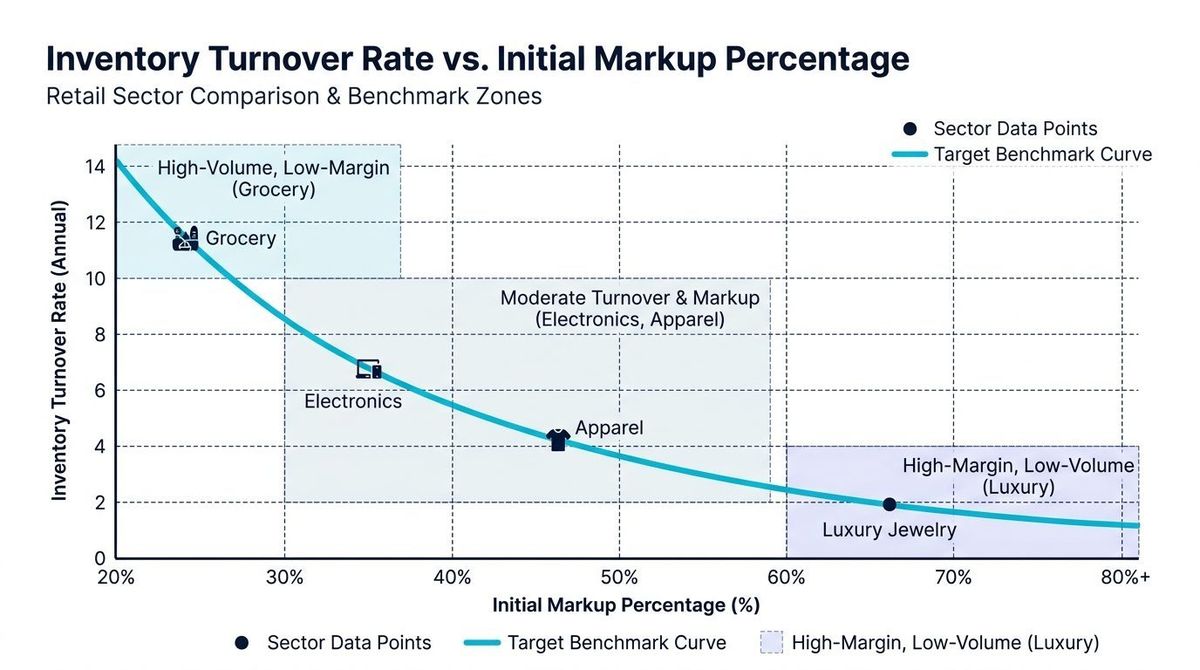
Initial markup expectations vary significantly across retail sectors based on inventory turnover speed, perishability, seasonal fashion obsolescence, and average store shrinkage rates.
| Retail Merchandise Category | Target Gross Margin | Average Reductions | Required IMU % | Inventory Turnover / Yr | Primary Margin Vulnerability |
|---|---|---|---|---|---|
| Fast Fashion & Trend Apparel | 45% – 52% | 22% – 32% | 58% – 66% | 4.5 – 6.0x | Steep end-of-season clearance |
| Footwear & Athletic Shoes | 42% – 48% | 14% – 20% | 52% – 58% | 3.0 – 4.2x | Broken size assortment markdowns |
| Consumer Electronics & Hardware | 18% – 28% | 4% – 8% | 24% – 32% | 6.0 – 8.5x | Rapid tech obsolescence & price drops |
| Specialty Grocery & Gourmet | 32% – 38% | 6% – 12% | 38% – 44% | 12.0 – 18.0x | Perishable spoilage & expiration shrink |
| Luxury Jewelry & Timepieces | 50% – 60% | 8% – 15% | 58% – 65% | 1.2 – 2.0x | High inventory carrying interest cost |
Fast-fashion apparel requires an aggressive initial markup of up to 66% to withstand 30% reduction rates, whereas grocery retailers maintain lower IMU percentages (38% to 44%) by maximizing inventory velocity.
Cashier Point-of-Sale Controls and Shrinkage Mitigation
Even the most rigorously calculated IMU strategy collapses if staff at the checkout counter grant unauthorized manual markdowns or misapply discount codes. Retail operational audits reveal that cashier error, unrecorded damaged item write-offs, and unauthorized "sweethearting" discounts account for up to 35% of total store inventory shrinkage.
Protecting your store's initial markup requires implementing strict POS permission protocols and modern employee till training. Introducing structured gamified checkout simulations, such as the Till Trainer cashier training module, trains front-line cashiers to handle split payments, promotional barcode scans, and manager override thresholds accurately, locking in your hard-earned initial markup percentages before transactions clear.
Frequently Asked Questions
What is the difference between markup and margin in retail?
Markup expresses the profit dollar amount as a percentage of wholesale cost (\(\text{Profit} / \text{Cost}\)), whereas gross margin expresses profit as a percentage of retail selling price (\(\text{Profit} / \text{Retail Price}\)). A 50% markup on cost equals a 33.3% gross margin on retail.
Can initial markup ever be lower than gross margin?
No. Unless retail operations generate negative reductions (which is impossible) or receive enormous supplier rebates exceeding all store markdowns and theft combined, initial markup must always be equal to or greater than maintained gross margin.
How do seasonal clearances affect next year's IMU planning?
If last year's clearance markdowns exceeded projections by 4%, your buyer must either negotiate lower wholesale costs with vendors or elevate next season's IMU targets by 2% to 3% to preserve net cash flow.
Why do cash discounts earned subtract from the numerator?
Cash discounts earned (such as prompt payment terms) reduce net cost of goods sold. Because they provide financial income outside customer retail sales, they lower the margin pressure required from consumer ticket pricing.
Master Your Merchandising Profit Calculations
Never rely on guesswork when setting wholesale-to-retail prices. Calculate dynamic markups, markdown sensitivity models, and inventory turn metrics with precision using our suite of retail merchandising tools at Retail Margin Calculator.