5 Critical Audit Formulae to Stop Retail Inventory Shrinkage and Boost GMROI
For multi-unit retail operators and store directors, inventory shrinkage is a quiet margin destroyer. Shrinkage—the difference between recorded inventory on your balance sheet and actual physical stock counted in store—directly erodes gross profit margins and starves operational cash flow.
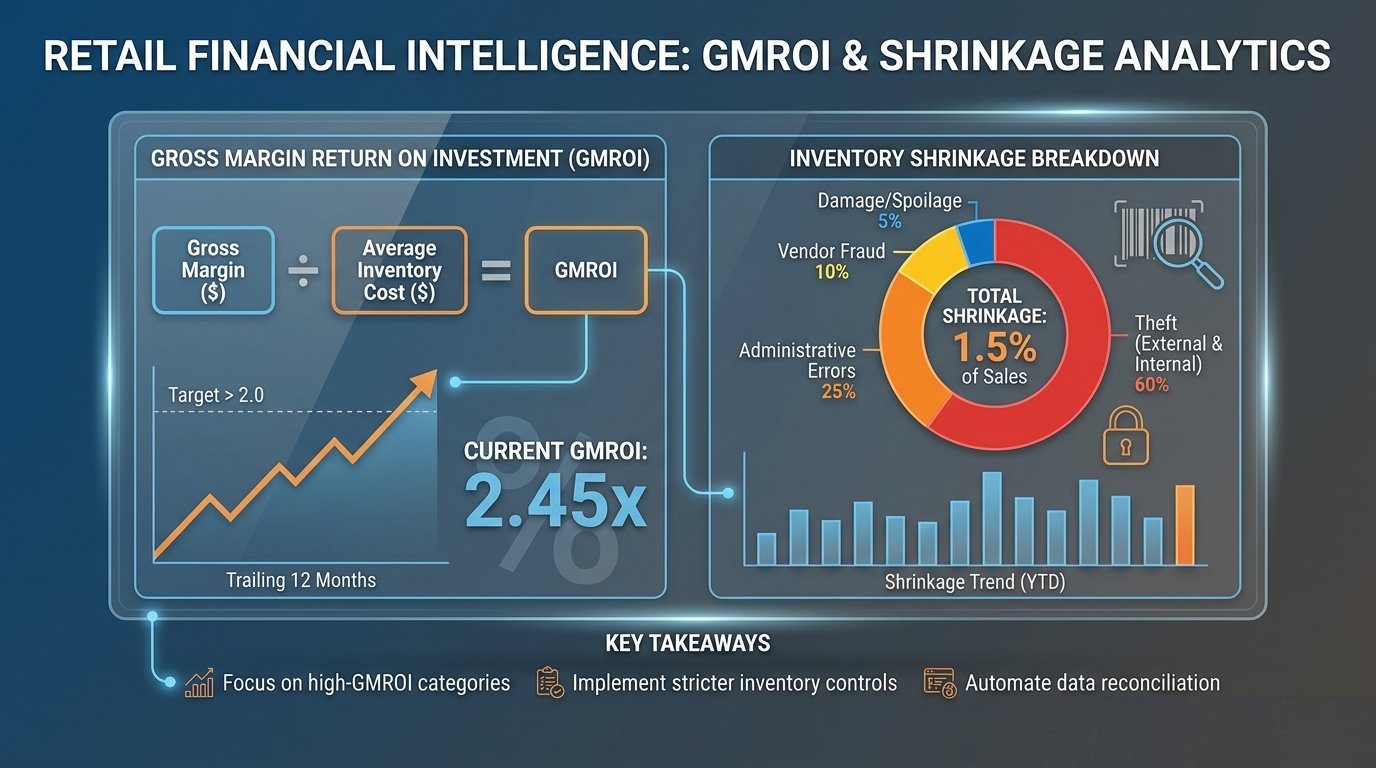
In modern retail management, unmonitored inventory loss doesn't just reduce net earnings; it severely impairs your Gross Margin Return on Investment (GMROI). Every dollar of unaccounted stock lost to shoplifting, administrative clerical errors, or vendor fraud requires significantly higher top-line revenue just to recover lost capital.
By instituting a structured, quantitative audit framework, store operators can identify root-cause variances, recalibrate inventory valuation models, and protect bottom-line profitability.
Quick Answer / Key Takeaways * Shrinkage Percentage Formula: Shrinkage (%) = (Book Inventory Value - Physical Inventory Value) / Total Retail Sales × 100. * Industry Benchmark: According to national retail loss benchmarks, average inventory shrinkage sits between 1.4% and 1.6% of total retail sales. * GMROI Impact: Shrinkage inflates average inventory holding costs while reducing realized gross margin, compounding cash flow inefficiencies.

Categorizing Administrative, Theft, and Vendor Shrinkage
Before applying quantitative formulas, retail auditors must categorize inventory discrepancies into distinct operational loss buckets:
- Customer Shoplifting & Organized Retail Crime (ORC): External theft targeting high-velocity, high-margin merchandise.
- Employee Theft & Internal Dishonesty: Unauthorized discounts, fake returns, or direct physical asset theft by staff.
- Administrative & Clerical Errors: Paperwork miscounts, duplicate receiving logs, barcode scan errors, and unrecorded price markdowns.
- Vendor & Supplier Fraud: Shortages in delivered carton counts or inaccurate master-pack invoice billing at the receiving dock.
When shrinkage exceeds 2.0% of retail sales, it signals structural control failures in both receiving dock procedures and point-of-sale (POS) reconciliation.
The 5 Essential Shrinkage Audit Formulas & GMROI Linkage
To perform a rigorous inventory variance audit, financial managers rely on 5 core mathematical formulas.
1. Total Retail Shrinkage Dollar Value Shrinkage Dollar Loss ($) = Book Value of Inventory ($) - Physical Count Value ($)
2. Retail Shrinkage Percentage Rate Shrinkage Rate (%) = (Shrinkage Dollar Loss ($) / Total Retail Sales Revenue ($)) × 100
3. Gross Margin Return on Investment (GMROI) GMROI = Gross Profit ($) / Average Inventory Cost ($)
4. Break-Even Sales Volume to Recover Shrinkage Required Recovery Sales ($) = Shrinkage Dollar Loss ($) / Gross Margin Percentage (%)
5. Variance Cost Factor per SKU Group SKU Variance Factor = (Unexplained Units Lost / Total Units Received) × Unit Cost ($)
| Audit Metric | Formula Inputs | Target Benchmark | Primary Financial Risk |
|---|---|---|---|
| Shrinkage Rate (%) | Book Inventory vs. Physical Count | < 1.25% of Sales | Net profit margin reduction and tax over-reporting |
| GMROI Ratio | Gross Profit / Avg Inventory Cost | > 2.50 | Tied-up working capital and reduced stock turnover |
| Recovery Sales ($) | Shrinkage ($) / Gross Margin (%) | Varies by Margin | Severe top-line sales pressure to cover fixed overhead |
| SKU Variance Factor | Missing Units / Total Received Units | < 0.5% per Category | Phantom inventory causing stock-outs and lost sales |
For comprehensive industry benchmark statistics and loss prevention survey standards, explore the National Retail Federation (NRF) Security and Loss Prevention Survey Guidelines.
Break-Even Unit Volume Adjustment Framework
When shrinkage occurs, businesses don't just lose the wholesale cost of the item; they lose the anticipated gross margin dollar contribution.
For example, if a store experiences $10,000 in inventory shrinkage and operates on a 25% Gross Margin, the business must generate $40,000 in additional sales volume just to break even on the lost stock:
Required Recovery Sales = $10,000 / 0.25 = $40,000
This multiplier effect demonstrates why reducing shrinkage by just 50 basis points (0.5%) often yields a higher profit gain than a 5% increase in top-line marketing promotion.
Loss-Prevention Audit Checklist & Margin Protection
Implement these operational audit steps every cycle:
- Conduct Cycle Counts Weekly: Replace annual physical inventory counts with high-frequency cycle counts targeting top-tier SKUs (A-category items).
- Mandate Dual-Signoff Dock Receiving: Require two staff signatures for every vendor delivery invoice and double-check master-carton quantities.
- Reconcile POS Markdowns Daily: Audit price overrides and employee discount transactions against cash register logs.
- Isolate Phantom Stock in ERP Systems: Update inventory management software immediately after physical audits to prevent selling out-of-stock items online.
To evaluate your store's margin structure against fixed operating expenses and identify profit leaks, use our Retail Margin Calculator to quickly assess your GMROI and break-even requirements.
For broader business profitability analysis and income optimization strategies, visit The Income Audit to benchmark your retail operations against industry standards and identify scaling opportunities.