Retail Loyalty Points Liability and Redemption Margin Formula: 6 POS Deferred Revenue & Breakage Audit Calculations
Executive Retail Audit Summary: Launching a "Spend \( \$100 \), Get \( \$10 \) Off" customer rewards program on Square Loyalty or Shopify POS looks like a simple \( 10.0\% \) promotional discount on paper, but two accounting and margin traps routinely catch independent retailers off guard: unrecorded ASC 606 Deferred Contract Liability on outstanding points balances, and stacking loyalty redemptions on top of low-margin or clearance SKUs. By applying the 6 Retail Loyalty Points Liability and Redemption Margin Formulas below—factoring in empirical point breakage (\( b_{\text{pts}} = 22\% \text{ to } 38\% \)), standalone selling price allocation, and minimum-basket redemption guardrails—you can lock effective margin dilution under \( 3.6\% \) while driving a \( +29\% \) lift in repeat visit frequency. Audit your exact SKU margins with the Retail Margin Calculator.

1. Calculation 1 & 2: Standalone Selling Price (SSP) & ASC 606 Deferred Revenue Allocation
As independent merchants debate in r/smallbusiness customer retention comparisons and small business loyalty affordability threads, issuing loyalty points creates a separate performance obligation under GAAP (ASC 606-10-55-42). If a customer spends \( S_{\text{gross}} = \$100.00\text{ USD} \) and earns points worth \( V_{\text{face}} = \$8.00\text{ USD} \) (\( r_{\text{accrual}} = 8.0\% \)) in a program where historical point breakage (unredeemed/expired points) is \( b_{\text{pts}} = 25.0\% \) (so expected redemption rate is \( 1 - b_{\text{pts}} = 75.0\% \)), the Standalone Selling Price of the Points (\( \text{SSP}_{\text{pts}} \)) is:
\[ \text{SSP}_{\text{pts}} = S_{\text{gross}} \cdot r_{\text{accrual}} \cdot \left( 1 - b_{\text{pts}} \right) = \$100.00 \times 0.08 \times 0.75 = \$6.00\text{ USD} \]Under relative SSP allocation, you cannot book the full \( \$100.00\text{ USD} \) as day-one product revenue. Instead, you must defer \( L_{\text{deferred}} \) into a balance-sheet Loyalty Contract Liability account until those points are redeemed or expire:
\[ L_{\text{deferred}} = S_{\text{gross}} \cdot \left( \frac{\text{SSP}_{\text{pts}}}{S_{\text{gross}} + \text{SSP}_{\text{pts}}} \right) = \$100.00 \times \left( \frac{6.00}{106.00} \right) = \mathbf{\$5.66\text{ USD}} \]Your day-one recognized merchandise revenue is \( R_{\text{initial}} = \$100.00 - \$5.66 = \$94.34\text{ USD} \), while \( \$5.66\text{ USD} \) sits in deferred revenue liability.
| Loyalty Program Structure | Nominal Rebate (\( r_{\text{accrual}} \)) | Typical Breakage (\( b_{\text{pts}} \)) | ASC 606 Deferred Liability % | Effective COGS Margin Dilution |
|---|---|---|---|---|
| 5% Cash-Back Points (12-Mo Expiry) | \( 5.0\% \) (\( \$5\text{ per } \$100 \)) | \( 35.0\% \) Unredeemed | \( 3.15\% \) of Gross Sales | \( -1.56\% \) (at \( 52\% \) Base GM) |
| 8% Tiered Rewards (Rolling 18-Mo) | \( 8.0\% \) (\( \$8\text{ per } \$100 \)) | \( 25.0\% \) Unredeemed | \( 5.66\% \) of Gross Sales | \( -2.88\% \) (at \( 52\% \) Base GM) |
| 10% Punch Card (Buy 10, Get 1 Free) | \( 10.0\% \) (\( \$10\text{ per } \$100 \)) | \( 42.0\% \) Lost/Incomplete | \( 5.48\% \) of Gross Sales | \( -2.78\% \) (at \( 52\% \) Base GM) |
| Unrestricted 10% Digital Auto-Apply | \( 10.0\% \) (No Expiry/Threshold) | \( 8.0\% \) Unredeemed | \( 8.42\% \) of Gross Sales | \( -4.42\% \) (High Margin Erosion) |
2. Calculation 3 & 4: Retail Face-Value vs Wholesale COGS Cost of Reward Fulfillment
One of the biggest financial advantages of redeeming points for in-store merchandise rather than cash rebates is that fulfilling a \( \$10.00\text{ USD} \) reward only costs the merchant the wholesale replacement cost of goods sold: \( \text{COGS}_{\text{reward}} = V_{\text{redeemed}} \cdot (1 - m_{\text{gross}}) \). Across an entire customer cohort generating initial sales \( S_{\text{gross}} \) at baseline gross margin \( m_{\text{gross}} \), the Net Realized Gross Margin After Loyalty (\( \text{GM}_{\text{net-loyalty}} \)) without basket overspend is:
\[ \text{GM}_{\text{net-loyalty}} = \frac{S_{\text{gross}} \cdot m_{\text{gross}} - S_{\text{gross}} \cdot r_{\text{accrual}} \cdot \left( 1 - b_{\text{pts}} \right) \cdot \left( 1 - m_{\text{gross}} \right)}{S_{\text{gross}}} = m_{\text{gross}} - r_{\text{accrual}} \cdot \left( 1 - b_{\text{pts}} \right) \cdot \left( 1 - m_{\text{gross}} \right) \]Notice the power of this equation: if your store operates at a \( 55.0\% \) gross margin (\( 1 - m_{\text{gross}} = 0.45 \) COGS ratio) and runs an \( 8.0\% \) points program with \( 30.0\% \) breakage (\( 1 - b_{\text{pts}} = 0.70 \)), the true wholesale cost of fulfilling those rewards is only \( 0.08 \times 0.70 \times 0.45 = \mathbf{2.52\%} \) of revenue—reducing your realized gross margin from \( 55.0\% \) to \( 52.48\% \), not \( 47.0\% \)!

3. Calculation 5 & 6: Minimum-Basket Redemption Guardrails & Repeat Visit Profit Lift
As store owners point out in r/smallbusiness repeat customer acquisition discussions, a loyalty program fails when customers walk in with a \( \$10.00\text{ USD} \) reward, grab a \( \$10.00\text{ USD} \) item, and walk out paying \( \$0.00\text{ USD} \). By enforcing a \( 2.5\times \) Minimum Basket Redemption Threshold (for example, requiring a \( \$25.00\text{ USD} \) minimum purchase to apply a \( \$10.00\text{ USD} \) reward voucher), the redemption visit generates net new gross profit \( \Pi_{\text{redemption-visit}} \):
\[ \Pi_{\text{redemption-visit}} = \left( B_{\text{min-basket}} - V_{\text{reward}} \right) - B_{\text{min-basket}} \cdot \left( 1 - m_{\text{gross}} \right) = B_{\text{min-basket}} \cdot m_{\text{gross}} - V_{\text{reward}} \text{ USD} \]At a \( 55.0\% \) gross margin, when a shopperredeems a \( \$10.00\text{ USD} \) reward on a \( \$28.00\text{ USD} \) basket (\( \$18.00\text{ USD} \) cash collected at register, \( \$12.60\text{ USD} \) wholesale COGS), the store still nets \( +\$5.40\text{ USD} \) in positive gross profit on the redemption transaction itself—before even counting the incremental visits driven during the accrual phase!
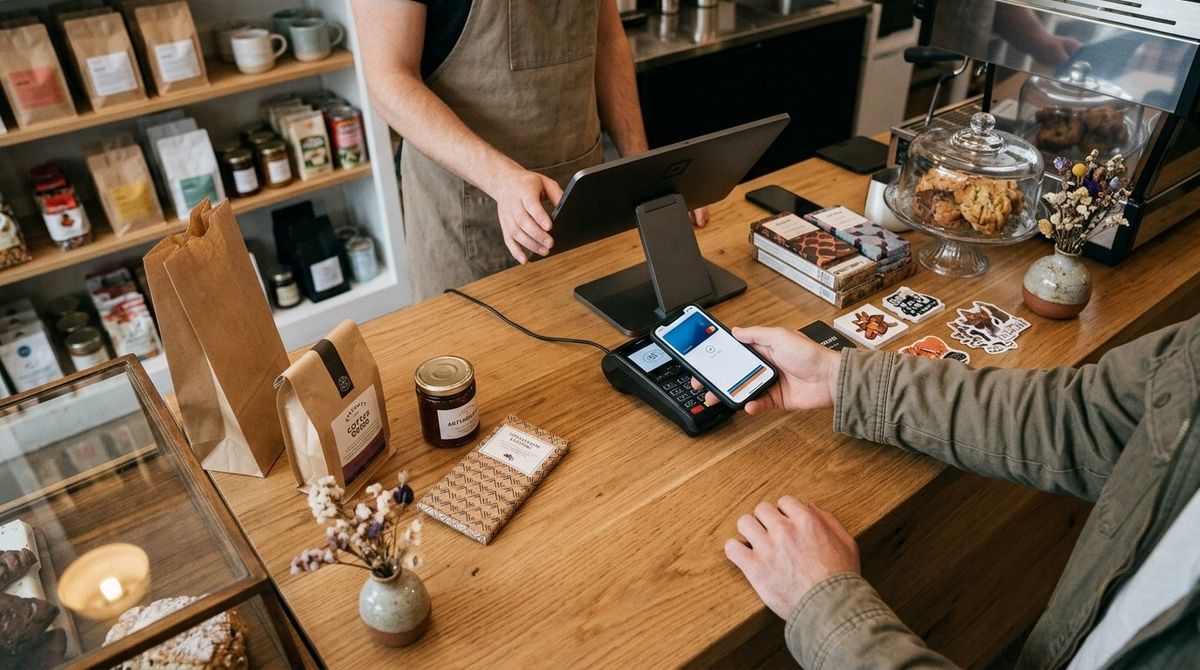
4. 3 Mandatory POS Rules to Prevent Loyalty Margin Bleed
- Exclude Clearance & Sub-35% Margin SKUs from Point Accrual and Redemption: Configure your POS category rules so promotional items, consignment goods, and low-margin hardware neither earn points nor accept reward vouchers.
- Enforce a Rolling 12-Month Inactivity Expiration Policy: Unlike paid gift cards (which are protected by 5-year federal CARD Act rules), promotional loyalty points can legally expire after \( 9 \) to \( 12\text{ months} \) of account inactivity when clearly disclosed in your terms—allowing you to release dormant balance-sheet liabilities into revenue.
- Cap Reward Vouchers at 40% of Any Single Ticket: Requiring at least \( 60\% \) of the checkout basket to be paid in cash/card ensures that every redemption covers 100% of wholesale COGS plus credit card processing fees.
5. Recommended Retail POS & Loyalty Hardware
- Square Register Dual-Screen POS Terminal — Native phone-number loyalty check-in on the customer-facing display with automated category exclusions and expiration rules.
- Socket Mobile S720 Bluetooth 1D/2D QR & Barcode Scanner — Scans Apple Wallet / Google Wallet digital loyalty passes and SKU barcodes simultaneously.
- Programmable NTAG215 NFC & Barcode PVC VIP Loyalty Cards (100-Pack) — High-retention physical VIP cards for boutiques, coffee roasters, and specialty retailers.
Audit Your Store's Loyalty Dilution, Breakage & Minimum Basket Thresholds
Run your exact SKU COGS, point accrual rates, and redemption rules through our interactive margin calculator.
Open the Retail Margin Calculator