Retail Promotional Markdown Volume Lift Formula: 5 Essential Rules to Protect Contribution Margin
Running a storewide "20% Off Weekend Sale" is the fastest way for an independent retailer or e-commerce brand to generate a record-breaking revenue spike while quietly losing money on the bottom line. Store owners frequently assume that offering a 20% promotional markdown means they simply need to sell 20% more units to make the same profit. In financial reality, because your wholesale cost of goods sold (COGS), outbound shipping, and payment processing fees remain fixed per unit, every single dollar of a promotional discount comes 100% out of your unit contribution margin.
In this retail profitability guide, we derive the exact Promotional Markdown Break-Even Volume Lift Formula, audit a real-world $50 SKU showing why a 20% discount on a 46% contribution margin demands a staggering +76.92% unit sales surge just to break even, and lay out five operational guardrails—including point-of-sale staff training—to stop margin bleed. Before launching your next promo code, run your SKU numbers through the Retail Margin Calculator.
Executive Profit Warning: The Discount Leverage Trap
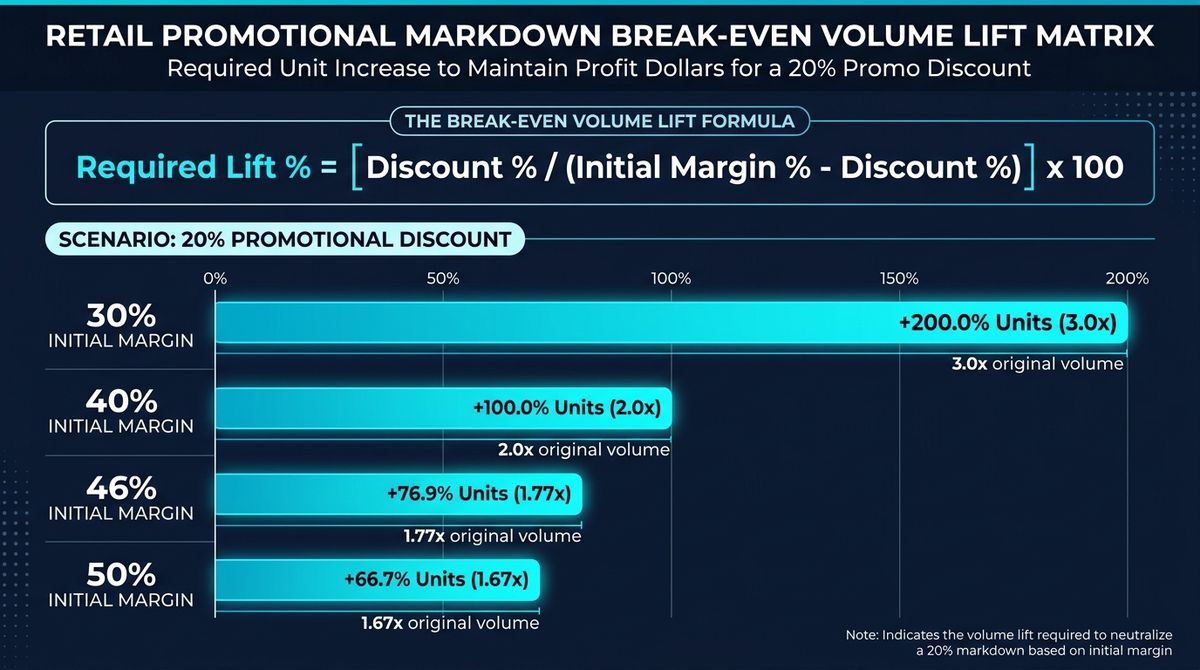
- At a 50% Initial Contribution Margin: A 20% promotional discount slashes unit profit by 40% and requires +66.7% more unit volume just to generate the exact same gross profit dollars.
- At a 40% Initial Contribution Margin: A 20% promotional discount cuts unit profit in half and requires +100.0% more unit volume (double your normal sales!) to break even.
- At a 30% Initial Contribution Margin: A 20% promotional discount wipes out two-thirds of unit profit and requires +200.0% more unit volume (3× normal sales) to avoid losing money!
The Retail Promotional Markdown Break-Even Volume Lift Formula
To determine how many additional units you must sell during a promotional markdown to earn the exact same total contribution profit dollars as before the sale, start with your baseline Unit Contribution Margin (\(M_{\text{initial}}\)):
Note that true variable cost per unit must include both landed wholesale product cost (\(C_{\text{COGS}}\)) and per-order variable fulfillment/payment fees (\(C_{\text{variable}}\), such as pick-pack materials, shipping subsidies, and 2.9% + $0.30 card or 6% BNPL fees). When you apply a promotional discount percentage (\(D_{\text{promo}}\)) to the retail price, your Required Break-Even Unit Volume Lift (\(\text{Lift \%}\)) is governed by the rational hyperbolic equation:
Step-by-Step Worked Audit: Why a 20% Sale Requires +76.92% More Units
Let us audit a real-world retail product priced at \(P_{\text{retail}} = \$50.00\) that normally sells 100 units per week:
- Calculate True Variable Unit Cost: Wholesale landed COGS is $18.00, plus variable fulfillment, packaging, and payment processing fees of $9.00 per unit, totaling $27.00 in variable cost per unit.
- Calculate Baseline Contribution Margin (\(M_{\text{initial}}\)): $$\text{Unit Contribution} = \$50.00 - \$27.00 = \mathbf{\$23.00\text{ per unit}} \quad \Longrightarrow \quad M_{\text{initial}} = \frac{\$23.00}{\$50.00} = \mathbf{46.0\%}$$ At 100 units per week, baseline weekly contribution profit is \(100 \times \$23.00 = \mathbf{\$2,300.00}\).
- Apply a 20% Promotional Markdown (\(D_{\text{promo}} = 20\%\)): The sale price drops by $10.00 to $40.00. Because variable costs remain $27.00, your discounted unit contribution margin plunges to: $$\text{Discounted Unit Profit} = \$40.00 - \$27.00 = \mathbf{\$13.00\text{ per unit}}$$
- Compute Break-Even Unit Volume & Percentage Lift: $$Q_{\text{break-even}} = \frac{\$2,300.00}{\$13.00} = \mathbf{176.92\text{ units}} \quad \Longrightarrow \quad \text{Lift (\%)} = \left(\frac{20\%}{46\% - 20\%}\right) \times 100 = \frac{20}{26} \times 100 = \mathbf{+76.92\%}$$ You must pack and ship 177 units instead of 100 units (+77% more physical work!) just to earn the exact same $2,300.00 in gross profit!
| Initial Margin (\(M_{\text{initial}}\)) | 10% Discount Lift Needed | 15% Discount Lift Needed | 20% Discount Lift Needed | 25% Discount Lift Needed |
|---|---|---|---|---|
| 30% Margin | +50.0% Units | +100.0% Units (2.0×) | +200.0% Units (3.0×) | +500.0% Units (6.0×) |
| 40% Margin | +33.3% Units | +60.0% Units | +100.0% Units (2.0×) | +166.7% Units (2.67×) |
| 46% Margin (Worked Ex.) | +27.8% Units | +48.4% Units | +76.9% Units (1.77×) | +119.0% Units (2.19×) |
| 50% Margin | +25.0% Units | +42.9% Units | +66.7% Units (1.67×) | +100.0% Units (2.0×) |
| 60% Margin | +20.0% Units | +33.3% Units | +50.0% Units (1.50×) | +71.4% Units (1.71×) |
5 Operational Rules to Run Promotions Without Destroying Margin
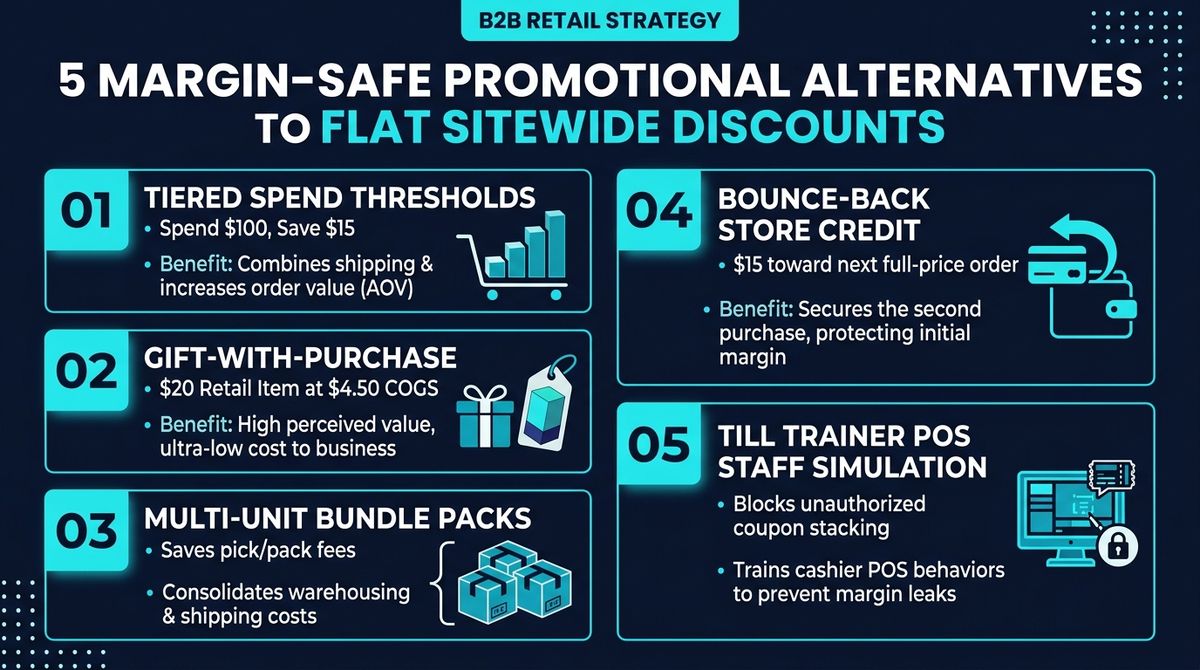
- Replace Flat Sitewide Discounts with Tiered Minimum-Spend Thresholds: Instead of "20% Off Everything" (which discounts single-unit orders), offer "Spend $100, Save $15" (where your current Average Order Value is $68). Customers add a second or third item to reach the $100 threshold, allowing you to ship three items in one box and save $6–$8 in combined fulfillment overhead.
- Use Gift-With-Purchase (GWP) Perceived Value Leverage: Offering a free accessory that retails for $20 but costs you $4.50 in wholesale COGS delivers a $20 perceived discount to the buyer while costing your margin only $4.50 (an effective 4.5% cost on a $100 basket).
- Exclude Low-Margin Anchor SKUs from Promo Codes: Never allow a 20% sitewide code to apply to sub-35% margin hardware or third-party brands where \(M_{\text{initial}} - D_{\text{promo}} < 15\%\).
- Account for Buy-Now-Pay-Later (BNPL) Merchant Fee Stacking: If a customer applies a 20% promo code and checks out via a BNPL provider charging a 6.0% merchant fee (instead of standard 2.9% card processing), your effective margin cut is 23.1%—pushing your break-even volume requirement on a 46% margin item to +100.9%.
- Eliminate Unauthorized Cashier Discount Stacking at the Register: In brick-and-mortar retail, one of the largest hidden margin leaks occurs when untrained seasonal cashiers manually stack a 15% loyalty coupon on top of a 20% clearance tag or process improper manual price overrides. Using structured interactive register simulation software like Till Trainer trains front-line POS staff on exact promotional override rules, coupon exclusion scanning, and cash-handling accuracy before they ever work a live holiday rush—protecting your hard-earned store margin at the counter.
Test Your Promotional Discount Math Before You Launch
Don't guess how a 15% or 20% sale will impact your bottom line. Plug your wholesale COGS, retail price, and discount percentage into our free calculator to see your exact break-even unit volume target instantly.
Open the Retail Margin Calculator →Step-by-Step Slicer & Calculator Verification Protocol
Before locking your production parameters, run a three-point verification check comparing your theoretical formula output against live slicer or register telemetry. Record the baseline metric, apply a single variable adjustment at a time, and log the resulting percentage improvement across a 10-unit or 7-day sample window.
Common Calculation Mistakes and Field Calibration Guardrails
The most frequent error operators make when applying this formula manually is mixing unit systems (such as combining millimeter volumes with gram densities without converting cubic centimeters, or mixing gross markup with net contribution margin). Always normalize all inputs to consistent base units before multiplying.
Frequently Asked Questions
Why does a 20% discount require more than a 20% increase in unit sales?
Because the 20% discount reduces your selling price while your wholesale COGS and fulfillment costs stay 100% unchanged. On a $50 item with $27 in variable costs ($23 profit), a 20% ($10) discount cuts your profit per unit from $23 down to $13—a 43.5% profit drop per unit that requires selling 76.9% more units to recover.
When does a deep clearance markdown (40%–50% off) actually make financial sense?
Deep markdowns make sense only when liquidating dead or seasonal inventory where the goal is cash-flow recovery and freeing up shelf/warehouse capital (converting stagnant inventory back into cash to buy high-velocity 60%-margin goods), rather than maximizing single-SKU profit.
How do tiered discounts ("Spend $100, Get $20 Off") improve contribution margin?
When a shopper increases their cart from 1 item ($50) to 2 items ($100) to unlock a $20 discount, you only pay for outbound shipping and box fulfillment once instead of twice—recovering $5 to $9 in variable shipping cost that offsets nearly half the promotional discount.