Retail On-Time In-Full (OTIF) Compliance Penalty, Supplier Fill-Rate Shortage & Lost-Sale Gross Margin Formula: 6 Supply-Chain Rules
Wholesale suppliers shipping into big-box distribution networks frequently lose between \( 2.8\% \) and \( 6.4\% \) of their invoiced revenue to automated compliance deductions before a single carton reaches a store shelf. Applying the retail OTIF compliance chargeback and fill rate margin formula lets you quantify how delivery window misses, case-level shorts, Advance Ship Notice (ASN) errors, and emergency buffer inventory erode your true pocket gross margin. You can model your SKU-level wholesale profitability directly inside the Retail Margin Calculator to stress-test purchase order terms before signing an annual vendor agreement.
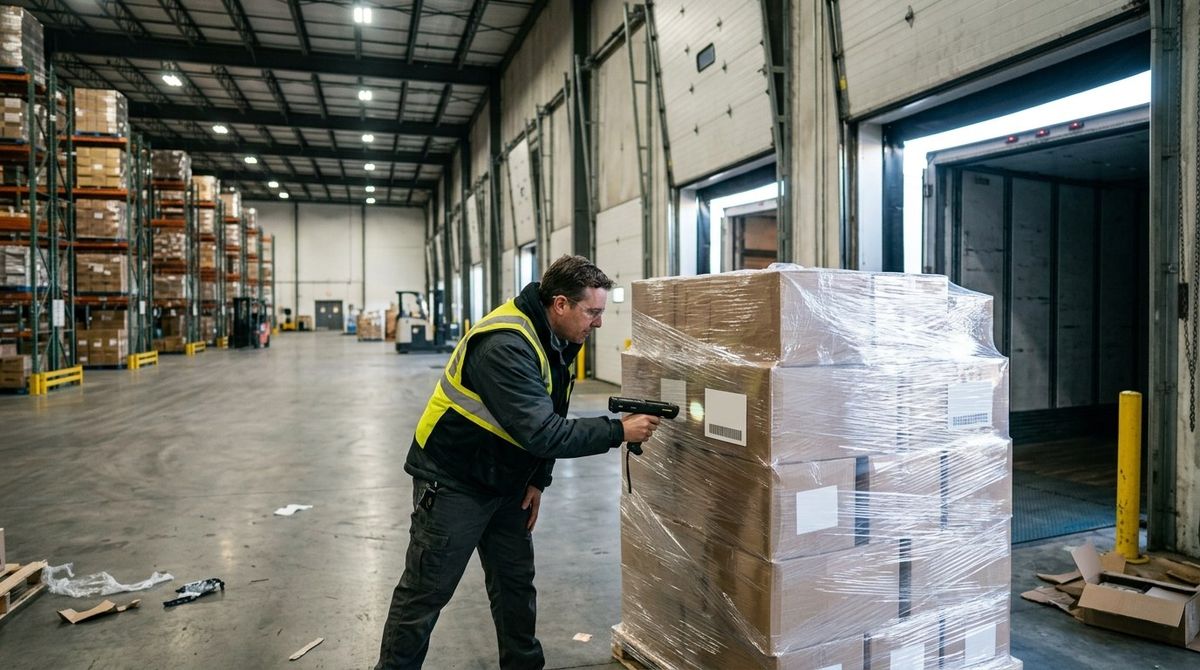
Executive Formula Summary: The Composite OTIF and Pocket Margin Engine
Big-box retail compliance engines evaluate supplier shipments using two multiplicative or intersection-based service thresholds alongside strict cost-of-goods-sold (COGS) penalty deductions:
\[ \text{OTIF\%}_{\text{composite}} = \text{On-Time Delivery\%} \times \text{Case Fill Rate\%} \] \[ C_{\text{OTIF}} = V_{\text{noncompliant PO}} \times r_{\text{penalty}} + N_{\text{ASN errors}} \times F_{\text{ASN}} \] \[ M_{\text{pocket}} = G_{\text{base}} - C_{\text{OTIF}} - L_{\text{shortage margin}} - H_{\text{safety stock}} \]When a wholesale vendor treats On-Time percentage and In-Full case fill rate as separate departmental metrics, the combined score almost always falls below big-box compliance gates. For example, achieving a \( 97.0\% \) On-Time rate alongside a \( 96.0\% \) Case Fill Rate yields a composite score of \( 0.970 \times 0.960 = 93.12\% \) — which triggers a \( 3.0\% \) noncompliance chargeback at retailers requiring \( 98.0\% \) on prepaid freight.
Rule 1: Derive the Multiplicative vs. Order-Intersection OTIF Score
Retailers calculate On-Time In-Full performance at either the purchase-order line level or the aggregate monthly case level. To prevent unexpected remittance deductions, you must track both the composite multiplicative formula and the strict order-intersection formula across every distribution center (DC) lane.
\[ \text{On-Time\%} = \left( \frac{Q_{\text{cases arrived within MABD window}}}{Q_{\text{cases shipped}}} \right) \times 100 \] \[ \text{Case Fill Rate\%} = \left( \frac{Q_{\text{cases received undamaged}}}{Q_{\text{cases ordered on PO}}} \right) \times 100 \] \[ \text{OTIF\%}_{\text{strict PO}} = \left( \frac{N_{\text{POs both On-Time AND 100\% Filled}}}{N_{\text{total POs due in period}}} \right) \times 100 \]- Prepaid Freight Thresholds: When the supplier controls carrier selection and routing (Prepaid), major mass merchandisers enforce a \( 98.0\% \) On-Time and \( 95.0\% \) In-Full threshold.
- Collect Freight Thresholds: When the retailer's fleet or designated third-party logistics (3PL) carrier picks up freight at your dock (Collect), the On-Time ready-to-ship threshold typically sits at \( 95.0\% \) with a \( 95.0\% \) In-Full case accuracy requirement.
- Early Arrival Penalties: Delivering a truckload \( 24\text{ hr} \) before the Must-Arrive-By-Date (MABD) window is graded identically to a late arrival because excess pallet staging clogs cross-dock lanes.
| Retailer Freight Tier | On-Time Target | In-Full Case Target | Minimum Composite OTIF | Standard COGS Chargeback Rate | Per-ASN / Label Defect Fee |
|---|---|---|---|---|---|
| Mass Merchandiser Prepaid | 98.0% | 95.0% | 93.10% | 3.0% of noncompliant PO value | $50.00 flat + $2.50 per carton |
| Mass Merchandiser Collect | 95.0% | 95.0% | 90.25% | 3.0% of noncompliant PO value | $50.00 flat + $2.50 per carton |
| National Grocery Chain | 97.0% | 96.0% | 93.12% | 2.5% of late/short case value | $75.00 per EDI 856 mismatch |
| Big-Box Home Improvement | 96.0% | 95.0% | 91.20% | 3.5% of late PO invoice value | $100.00 flat + $5.00 per pallet |
| Specialty Department Store | 95.0% | 94.0% | 89.30% | 5.0% of late seasonal PO value | $40.00 flat + $1.75 per garment |
Rule 2: Calculate Noncompliance Chargebacks and EDI 856 ASN Deductions
Retailer accounts-payable systems automatically deduct compliance fees from your next remittance advice (EDI 820) whenever a purchase order misses its MABD window or arrives with unannounced shorts. Even worse, if your warehouse ships \( 480 \) cases against a \( 500\text{-case} \) purchase order but transmits an EDI 856 Advance Ship Notice claiming \( 500 \) cases, you trigger both a fill-rate shortage chargeback and an ASN inaccuracy penalty.
\[ C_{\text{total deduction}} = \left( Q_{\text{late cases}} \times P_{\text{wholesale}} \times r_{\text{OT}} \right) + \left( Q_{\text{short cases}} \times P_{\text{wholesale}} \times r_{\text{IF}} \right) + F_{\text{EDI 856}} \]- Whole-PO vs. Defective-Case Assessment: Some vendor agreements assess the \( 3.0\% \) penalty solely against the dollar value of the missing or late cases (\( Q_{\text{short}} \times P_{\text{wholesale}} \)), whereas stricter contracts apply the \( 3.0\% \) deduction across the entire purchase order value \( V_{\text{PO}} \) if a single SKU line falls below \( 95.0\% \) —
- GS1-128 Barcode Scannability: If a shrink-wrap reflection or thermal ribbon wrinkle renders a pallet SSCC-18 label unreadable at the receiving door, the retailer assesses a manual re-labeling fee of \( \$50.00 \) per bill of lading plus \( \$2.50 \) to \( \$5.00 \) per carton.
- Cancel-After-Date Unfilled Shorts: When a purchase order carries a strict cancel date, any unshipped shortage cannot be backordered; you forfeit both the wholesale revenue and the gross margin on every unshipped case.
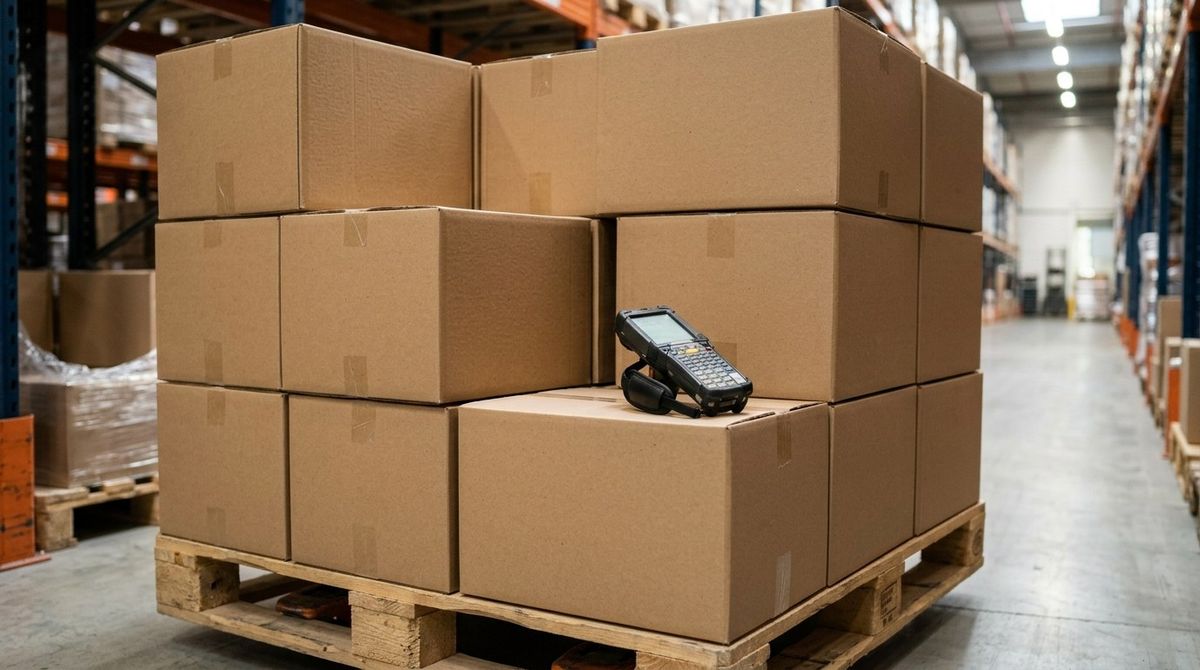
Rule 3: Quantify Fill-Rate Shortage Lost-Sale Gross Margin
Most accounting teams track chargebacks as a selling expense but ignore the silent profit destruction caused by unshipped cases on kill-or-fill purchase orders. When your production line shorts \( 4\% \) of a \( \$250{,}000 \) monthly retail order book, you lose the entire wholesale contribution margin on the unshipped \( \$10{,}000 \) slice while still paying fixed overhead and chargeback penalties.
\[ L_{\text{shortage margin}} = Q_{\text{ordered}} \times \left( 1 - \text{Fill Rate} \right) \times \left( P_{\text{wholesale}} - C_{\text{variable unit}} \right) \]- Wholesale Contribution Margin Loss: If a master carton sells to the retailer for \( P_{\text{wholesale}} = \$100.00 \) with a variable manufacturing and outbound freight cost of \( C_{\text{variable}} = \$68.00 \) — every shorted case erases \( \$32.00 \) in pure contribution profit.
- Compound Penalty Effect: If that same shorted case also triggers a \( 3.0\% \) In-Full noncompliance chargeback (\( \$3.00 \) per shorted case), the total economic loss per missing case reaches \( \$32.00 + \$3.00 = \$35.00 \) —
- Instock Algorithm Demotion: Persistent case fill rates below \( 94.0\% \) reduce automated replenishment safety thresholds in the retailer's forecasting engine, shrinking future purchase order volumes by \( 8\% \) to \( 15\% \) over the subsequent two quarters.
Rule 4: Model Pocket Wholesale Margin After Compliance and Buffer Holding Costs
To prevent case shortages and late truckloads, vendors hold dedicated buffer inventory (safety stock) in a regional 3PL warehouse. However, carrying extra pallets ties up working capital and incurs monthly storage fees. You must compute your net pocket margin \( m_{\text{pocket}\%} \) after subtracting OTIF chargebacks, ASN fees, lost-sale margin, and safety-stock holding cost from your baseline gross margin.
\[ H_{\text{safety stock}} = Q_{\text{buffer cases}} \times C_{\text{variable unit}} \times \left( \frac{r_{\text{annual holding}}}{12} \right) \] \[ m_{\text{pocket}\%} = \left( \frac{G_{\text{actual shipped}} - C_{\text{OTIF}} - F_{\text{ASN}} - H_{\text{safety stock}}}{V_{\text{actual shipped}}} \right) \times 100 \]| Monthly Vendor Scenario (2,500 Cases Ordered at $100/Case = $250,000 PO) | Scenario A: Unbuffered & Noncompliant (92% OT / 94% IF) | Scenario B: Partial Buffer & Borderline (96% OT / 96% IF) | Scenario C: Optimized Safety Stock (99% OT / 99% IF) |
|---|---|---|---|
| Actual Cases Shipped & Invoiced | 2,350 cases ($235,000) | 2,400 cases ($240,000) | 2,475 cases ($247,500) |
| Composite OTIF Score | 86.48% (Fails 93.10% gate) | 92.16% (Fails 93.10% gate) | 98.01% (Passes 93.10% gate) |
| Baseline Gross Margin ($32.00/case or 32.0%) | $75,200.00 | $76,800.00 | $79,200.00 |
| Lost Gross Margin on Unshipped Shorts | -$4,800.00 (150 cases short) | -$3,200.00 (100 cases short) | -$800.00 (25 cases short) |
| 3.0% OTIF Penalty + EDI/ASN Defect Fees | -$7,050.00 - $450.00 = -$7,500.00 | -$2,160.00 - $150.00 = -$2,310.00 | $0.00 (Zero chargebacks) |
| Monthly Safety-Stock Holding Cost (24% Annual Rate) | $0.00 (0 buffer cases) | -$408.00 (300 buffer cases) | -$816.00 (600 buffer cases) |
| Net Pocket Gross Profit ($) & Pocket Margin (%) | $67,700.00 (28.81% pocket margin) | $74,082.00 (30.87% pocket margin) | $78,384.00 (31.67% pocket margin) |
Notice how moving from Scenario A (\( 86.48\% \) composite OTIF) to Scenario C (\( 98.01\% \) composite OTIF) costs \( \$816.00 \) per month in safety-stock holding expenses for \( 600 \) buffer cases, but recovers \( \$7{,}500.00 \) in compliance penalties and captures \( \$4{,}000.00 \) in additional shipped case margin—producing a net monthly profit gain of \( \$10{,}684.00 \) — You can run this exact sensitivity table for your own SKU catalog using the Retail Margin Calculator.
Rule 5: Compute Break-Even Fill-Rate Recovery Volume
When a compliance deduction hits your remittance statement, sales teams often underestimate how many additional compliance-free cases must be shipped just to recover the lost cash. Because every replacement case carries variable COGS and outbound freight, you must divide the total deduction dollar amount by your net contribution margin per case (or net pocket margin percentage).
\[ Q_{\text{break-even cases}} = \frac{C_{\text{OTIF}} + F_{\text{ASN}}}{P_{\text{wholesale}} - C_{\text{variable unit}}} \] \[ \Delta V_{\text{break-even revenue}} = \frac{C_{\text{OTIF}} + F_{\text{ASN}}}{m_{\text{net}\%}} \]- Step 1 — Sum Total Monthly Compliance Deductions: Take the total OTIF penalty and ASN fee from Scenario A: \( \$7{,}050.00 + \$450.00 = \$7{,}500.00 \) —
- Step 2 — Divide by Unit Contribution Margin: Divide \( \$7{,}500.00 \) by the \( \$32.00 \) per-case gross contribution margin: \( \frac{\$7{,}500.00}{\$32.00} = 234.375 \approx 235\text{ additional cases} \) —
- Step 3 — Convert to Required Replacement Revenue: Multiply \( 234.375 \) cases by \( \$100.00 \) per case (or divide \( \$7{,}500.00 \) by \( 0.32 \)): you must ship \( \$23{,}437.50 \) in completely penalty-free wholesale orders just to break even on a single month's chargebacks.
- Step 4 — Compare Against Safety-Stock Z-Score Cost: Sizing safety stock to the \( 99\% \) service level (\( Z = 2.33 \)) using \( \text{SS} = Z \times \sigma_{d} \times \sqrt{L} \) requires only \( \$816.00 \) per month in holding cost, yielding a \( 13.1\times \) return on working capital.
Rule 6: Audit 3PL SLA Pass-Through and Collect-Carrier Dispute Windows
Many emerging wholesale brands outsource warehousing to a third-party logistics (3PL) provider without aligning the 3PL's contractual Service Level Agreement (SLA) to the retailer's MABD rules. If your 3PL contract guarantees a \( 48\text{-hour} \) order turnaround with a \( 1.0\% \) shipping error allowance, but your retail customer enforces a \( 98.0\% \) OTIF gate with a \( 3.0\% \) COGS penalty, your brand absorbs the entire compliance gap.
| Chargeback Dispute & SLA Control Vector | Root Cause of Margin Leakage | Required Operational Fix | Target Documentation / Proof Artifact |
|---|---|---|---|
| Collect Carrier Late Pickup | Retailer-routed carrier arrives 1 day after ready date; supplier billed 3% OTIF fee | Time-stamp dock check-in and log carrier delay inside retailer routing portal within 24 hours | Signed Bill of Lading (BOL) with carrier arrival/departure time stamps |
| EDI 856 ASN vs. Physical Count | 3PL transmits ASN from original PO quantity instead of actual pallet scan count | Lock WMS so EDI 856 transmits strictly from closed-pallet SSCC-18 barcode scans | WMS scan audit log matching pallet SSCC-18 serial numbers to physical cases |
| Early MABD Delivery Rejection | Less-than-truckload (LTL) carrier drops freight 2 days before MABD window | Print mandatory MABD appointment window in bold on BOL and require carrier appointment confirmation | Retailer scheduling portal confirmation number + carrier delivery receipt |
| 3PL Mispick / Case Shortage | 3PL caps liability at $50 per order while retailer deducts $1,500 on a $50,000 PO | Negotiate bonus/malus chargeback pass-through clause capped at 50% of monthly 3PL storage billing | Signed 3PL SLA addendum with explicit retail chargeback reimbursement schedule |
Frequently Asked Questions
Why is our retailer OTIF score lower than both our On-Time percentage and our Fill-Rate percentage?
Because On-Time delivery and In-Full case accuracy fail on different purchase orders, the combined probability of an order meeting both criteria simultaneously is the product (or strict set intersection) of the two rates. If \( 3\% \) of your orders arrive late (\( 97\% \) On-Time) and a separate \( 2\% \) of your orders ship short (\( 98\% \) In-Full), then \( 5\% \) of your total orders fail at least one requirement—dropping strict order-level OTIF to \( 95.0\% \) and multiplicative OTIF to \( 95.06\% \) —
Should we ship a partial purchase order on time or hold the truck for 24 hours to ship 100% in full?
Under almost all big-box vendor compliance programs, shipping available cases on time and transmitting an accurate EDI 856 ASN for the exact shipped quantity minimizes total deductions. Holding an entire \( \$50{,}000 \) purchase order past the MABD window to wait for \( 20 \) missing cases exposes \( 100\% \) of the invoice to a \( 3.0\% \) late penalty (\( \$1{,}500.00 \)), whereas shipping \( 96\% \) on time confines the penalty solely to the \( 4\% \) unshipped shortage value (\( \$60.00 \)).
How much gross margin buffer should we build into wholesale pricing for big-box retail accounts?
Always include a dedicated \( 1.5\% \) to \( 2.5\% \) compliance and safety-stock reserve inside your wholesale price waterfall before quoting landed COGS to a retail buyer. You can calculate the exact wholesale unit price required to protect a \( 30\%+ \) pocket margin using the Retail Margin Calculator.