Wholesale Volume Tier and 2/10 Net 30 Cash Discount Margin Formula: 5 Rules to Protect Net Profit
In B2B procurement and retail inventory management, supplier price sheets are designed to tempt buyers into larger Minimum Order Quantities (MOQs). A distributor quotes$18.00/unit at 100 units (Tier 1), drops the price to$15.30/unit at 500 units (Tier 2, -15%), and dangles$13.50/unit at 2,000 units (Tier 3, -25%)—while offering2/10 Net 30early-payment trade credit terms on the invoice. On the surface, jumping to Tier 3 looks like an instant 11.25-percentage-point gross margin expansion on a $40.00 retail SKU.
Yet as seasoned merchants inr/smallbusiness volume discount discussionsandslow-moving inventory auditsrepeatedly discover, over-ordering an MOQ tier traps working capital for 9 to 16 months, accumulates 24% annual inventory holding drag, and forces margin-destroying clearance markdowns—while unmonitored staff POS discounts at the checkout counter quietly bleed away whatever wholesale savings remained. In this completewholesale volume tier margin formulaguide, we derive the exact 2/10 Net 30 annualized return equation, model true landed and held unit cost across MOQ tiers, and show how to lock in your procurement gains from warehouse dock to customer receipt. Test your own SKU numbers anytime in ourRetail Margin Calculator.
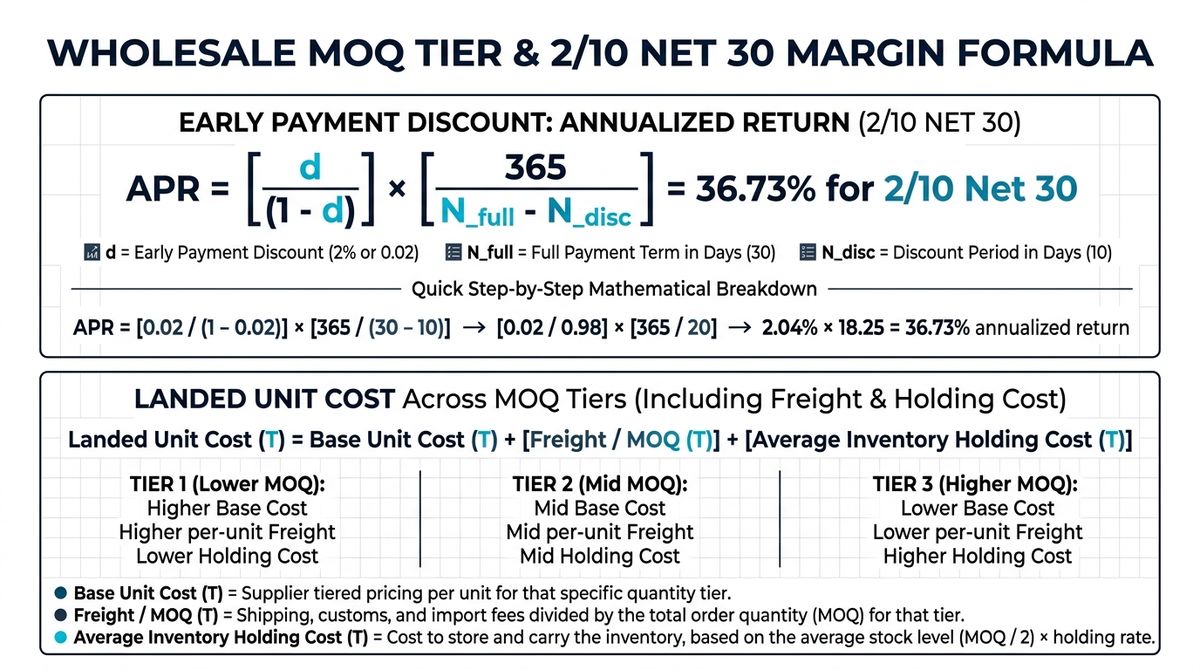
Executive Summary: Wholesale Procurement & Trade Credit Rules The 2/10 Net 30 Annualized Return Formula: $$\text{APR} = \left( \frac{d}{1 - d} \right) \times \left( \frac{360}{N_{\text{full}} - N_{\text{disc}}} \right) = \left( \frac{0.02}{0.98} \right) \times 18 = \mathbf{36.73\%\text{ APR}} \quad (\text{or }\mathbf{37.24\%}\text{ on a 365-day year})$$ The True Landed & Held MOQ Unit Cost Equation: Always add amortized inbound freight (F(T)/Q(T)) and time-weighted inventory holding cost (\(P_{\text{net}} \cdot r_{\text{hold}} \cdot (D_{\text{sell}} / 730)\)) before comparing supplier volume tiers. Checkout Margin Lock: A 2% early-payment wholesale discount is wiped out five times over if front-line cashiers grant unapproved 10% manual POS overrides at the register.
1. Rule 1: The 2/10 Net 30 Cash Discount Formula (Why 2% Equals 36.73% APR)
When a wholesale vendor prints2/10 Net 30on a purchase order, they are offering two distinct financing paths: pay the full invoice amount on Day 30, or deduct(d = 2%) ($0.02)if you remit payment within (\(N_{\text{disc}} = 10\text{ days}\)). Many small business owners dismiss a 2% discount as trivial compared to a 15% MOQ break. However, in corporate finance, skipping a 2/10 Net 30 discount means you are paying (2 / (100 - 2) = 2.0408%) interest just to borrow your supplier's money for the20-day windowbetween Day 10 and Day 30.
Let us write the general annualized effective interest rate formula for any cash discount term (\(d / N_{\text{disc}}\text{ Net } N_{\text{full}}\)):
Plugging in standard B2B trade terms reveals why profitable retailers always capture early-pay discounts:
- 2/10 Net 30: \(\frac{0.02}{0.98} \times \frac{360}{20} = 0.020408 \times 18 = \mathbf{36.73\%\text{ APR}}\) (360-day commercial bank year) or \(\mathbf{37.24\%\text{ APR}}\) (365-day calendar year).
- 1/10 Net 30: \(\frac{0.01}{0.99} \times \frac{360}{20} = 0.010101 \times 18 = \mathbf{18.18\%\text{ APR}}\) (360-day) or \(\mathbf{18.43\%\text{ APR}}\) (365-day).
- 3/10 Net 45: \(\frac{0.03}{0.97} \times \frac{360}{35} = 0.030928 \times 10.2857 = \mathbf{31.81\%\text{ APR}}\) (360-day).
Even if your business uses a revolving bank line of credit at9.5% APRto pay the supplier on Day 10 and repays the bank on Day 30, you earn a risk-free net arbitrage spread of (\(36.73\% - 9.50\% = \mathbf{+27.23\%\text{ annualized}}\)) without adding a single extra unit of inventory risk!
2. Rule 2: The True Landed & Held Unit Cost Formula Across MOQ Tiers
Why do retailers who stretch for a supplier's largest volume tier often end the fiscal year with lower net cash than retailers who buy the mid-tier? As merchants point out inr/smallbusiness wholesale tier threads, invoice unit price (\(P_{\text{unit}}(T)\)) omits three real cash drains: inbound LTL/parcel freight (\(F_{\text{freight}}(T)\)), average inventory holding cost over the sell-through period (\(D_{\text{sell}}(T)\)) (\(where average inventory held over linear sell-through is half the order quantity, so average holding duration is (D_{\text{sell}}/2), or across full cycle allocation (D_{\text{sell}}/365) on working capital\)), and end-of-cycle markdown risk (\(M_{\text{clear}}(T)\)):
Let us audit a real-world procurement decision for a specialty retail store selling a$40.00 MSRP kitchenware SKUat a steady velocity of125 units per month (4.17 units/day)with an annual inventory holding cost rate of(\(r_{\text{hold}} = 24\%\))(covering warehouse space, insurance, shrinkage—see ourRetail Inventory Shrinkage & GMROI Audit Guide—and cost of capital):
Procurement Metric
Tier 1: 100 Units (Starter MOQ)
Tier 2: 500 Units (Mid MOQ + 2/10 Net 30)
Tier 3: 2,000 Units (Bulk MOQ Overbuy)
Supplier Invoice Unit Price
$18.00 / unit (Net 30)
$15.30 / unit (-15% Volume Tier)
$13.50 / unit (-25% Volume Tier)
2/10 Net 30 Cash Discount (-2%)
$0.00 (Paid Day 30)
-$0.31 / unit ($14.99 Net Invoice)
$0.00 (Cash tied up in bulk PO)
Inbound Freight (\(F / Q_{\text{MOQ}}\))
$180 / 100 = +$1.80 / unit
$350 / 500 = +$0.70 / unit
$900 LTL / 2,000 = +$0.45 / unit
True Landed Cost at Dock
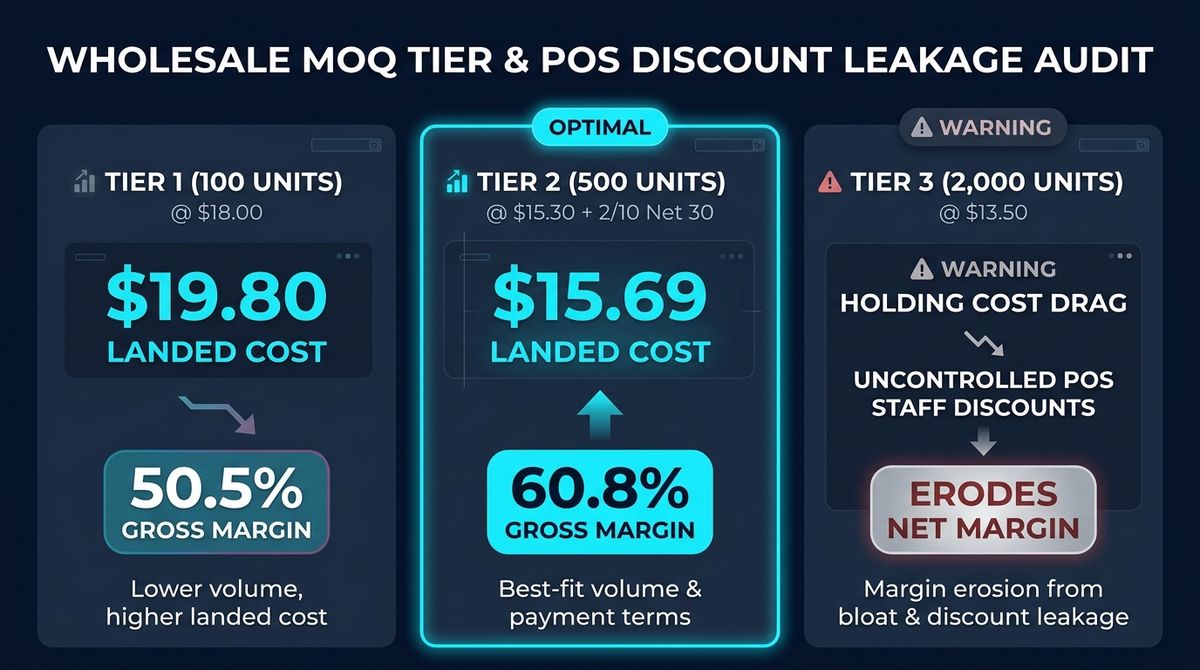
$19.80 / unit (50.5% Gross Margin)
$15.69 / unit (60.8% Gross Margin)
$13.95 / unit (Before Holding Drag)
Sell-Through Duration (\(D_{\text{sell}}\))
24 Days (0.8 Months)
120 Days (4.0 Months)
480 Days (16.0 Months!)
Capital Holding Drag & Clearance
+$0.16 / unit holding
+$0.62 / unit holding ($0 clearance)
+$2.20 holding + $3.20 clearance loss
Realized Net Unit Profit (@ $40)
$20.04 / unit
$23.69 / unit (OPTIMAL TIER)
$20.65 / unit (Cash Trapped 16 Mos)
Look at the numbers in the table above: stepping from Tier 1 (100 units) toTier 2 (500 units with 2/10 Net 30)drops landed cost from$19.80 to $15.69 per unit, lifting gross margin from50.5% to 60.8%while turning inventory three times per year. Stretching to Tier 3 (2,000 units) ties up $27,900 in cash for 16 months and forces a 25% clearance discount on the final 600 units (compare ourRetail Promotional Markdown Volume Lift Formula), erasing the entire bulk discount!
3. Rule 3: Calculating the Maximum Safe MOQ Velocity Ceiling
Before signing any wholesale purchase order, use ourMaximum Safe MOQ Formulato cap order quantity based on your verified daily sales velocity (\(V_{\text{daily}}\)) and your target inventory turnover window (\(D_{\text{max}}\)) (90 to 120 days maximum for non-perishable specialty retail):
If a supplier refuses to budge on a 1,000-unit MOQ for a SKU that sells 3 units per day (\(Q_{\text{max\_safe}} = 360\text{ units}\)), negotiate aBlanket Purchase Order with Split Drop-Ship Releases: commit to 1,000 units over 9 months at the Tier 2/3 price, but take physical delivery and invoice billing in three 333-unit quarterly tranches.
4. Rule 4: Freight Bracket Optimization (Parcel vs LTL Pallet Thresholds)
Inbound freight is non-linear. Ordering 180 units shipped via 12 individual UPS/FedEx ground cartons ($240 total = $1.33/unit) often costs almost the same in shipping as ordering 300 units consolidated on a single shrink-wrapped LTL pallet ($260 total = $0.87/unit). Always ask your vendor for theirCarton-per-Pallet Cube Countand order in exact full-layer or full-pallet multiples to minimize per-unit freight allocation (\(F_{\text{freight}}/Q\)) in yourRetail Break-Even Point Formula.
5. Rule 5: Protecting Wholesale Margin Gains at the Point of Sale (POS)
Winning an extra 2% via 2/10 Net 30 and 8% via freight-optimized Tier 2 MOQs accomplishes nothing if those basis points evaporate at the checkout counter. In many independent retail stores, untrained cashiers use the "Open Discount" or "Price Override" button to appease hesitant shoppers or friends—handing out ad-hoc 10% to 15% register discounts that slash a 60.8% gross margin straight down to 54.0%.
To seal that checkout leak permanently, pair your procurement math with structured front-of-house training usingTill Trainer—our interactive POS simulation and staff training platform built specifically to train retail cashiers on accurate transaction handling, discount permission boundaries, and error-free register workflows before they ever touch a live drawer. When your procurement team captures 2/10 Net 30 discounts at the back office andTill Trainerlocks down unauthorized discount overrides at the front register, every basis point of margin flows directly to net profit.
Calculate Your Exact Wholesale Landed Cost & Gross Margin Now Compare supplier MOQ volume tiers, inbound freight allocations, and retail markup percentages in seconds with our free interactive B2B margin calculator. Open the Retail Margin Calculator →
Frequently Asked Questions
How do you calculate the annualized return of 2/10 Net 30?
Divide the discount percentage by the discounted invoice complement ((0.02 / 0.98 = 2.0408%)), and multiply by the number of 20-day discount periods in a year ((360 / 20 = 18), or (365 / 20 = 18.25)). That yields36.73% APR on a 360-day commercial year(or37.24% APR on a 365-day year).
When should a retailer skip a supplier's wholesale volume discount tier?
Skip any MOQ volume tier that requires more than90 to 120 days of inventory sell-throughunless the unit discount exceeds your annualized inventory holding cost (~2% per month of extra storage) plus your historical end-of-season markdown rate.
Does inbound freight count toward Cost of Goods Sold (COGS) in retail margin math?
Yes. GAAP and IFRS accounting require inbound freight-in, customs duties, and drayage to be capitalized into inventory valuation (Landed Cost). Always calculate gross margin using True Landed Unit Cost rather than bare factory invoice price.
Run the Interactive Calculator: Use our Retail Margin Calculator to model your exact parameters and tolerances in real time.